Buy Now Pay Later (BNPL) schemes have quickly become one of the most notable financial innovations in India’s digital credit landscape. Sitting between traditional credit cards and short-term consumer loans, BNPL provides instant, small-ticket credit that allows consumers to buy goods and services and pay for them in flexible instalments. For many middle-income families in India, BNPL offers a convenient way to meet their spending needs without the demanding eligibility requirements that accompany formal lending options. One of the standout benefits of BNPL is its ability to help first-time or thin-file borrowers build their credit scores. When repayments are reported accurately to credit bureaus, timely BNPL payments can help these middle-income users establish a positive credit history, which in turn improves their chances of qualifying for future loans, such as education loans, housing finance or small business credit. In a country where a significant portion of the population is underserved by traditional credit institutions, BNPL can serve as a gateway into mainstream finance. However, the swift growth of BNPL also raises important issues relating to regulation, technology and consumer protection. The whole system relies heavily on data collection and sharing among fintech providers, merchants and lending partners, often without consumers being fully aware of it. This raises concerns about informed consent, data minimisation and the potential misuse of personal financial information. Moreover, the lack of transparency regarding interest-free periods, hidden fees, penalty structures and credit reporting practices can erode consumer trust. Marketing tactics frequently target low-income consumers with little financial literacy, students and people in their early careers. Such targeting raises concerns about exploitative lending practices and long-term financial instability. Many users do not realise how missed payments can harm their credit scores, and unclear terms and conditions can leave consumers at risk of falling into debt.
Thus, while BNPL schemes offer substantial benefits for financial inclusion and credit-score development among middle-income families, they simultaneously highlight the need for clear disclosure norms, responsible data practices and transparent regulatory frameworks. A balanced approach is essential to harness the advantages of BNPL while safeguarding consumer rights in India’s evolving digital economy.
1. “The Rise of Buy Now, Pay Later (BNPL) in India: Are Millennials Falling into a Debt Trap?” by Kabir Goel1 is useful in demonstrating the appeal of BNPL among younger and financially constrained consumers, particularly because of its convenience and its ability to increase short-term purchasing capacity. Nevertheless, its characterisation of BNPL as a potential “debt trap” requires stronger empirical support based on repayment behaviour, multiple borrowing and consumer indebtedness. The study also provides limited analysis of standard-form contracts, data practices and the regulatory responsibilities of BNPL providers and their lending partners. Therefore, while it contributes to an understanding of the behavioural drivers of BNPL adoption, it does not fully address the legal and consumer-protection dimensions examined in the present study.
2. “Buy Now Pay Later: A Revolution Challenged in India” by Akshay Aravind, Vijay Sanketh Bhandari, S. Pavanaj and Mohammed Sunoosh Beary2 provides a balanced account of BNPL by identifying both its financial-inclusion potential and its risks relating to transparency, financial literacy and regulatory oversight. However, the recommendation for licensing remains relatively general and is not supported by a detailed examination of the legal classification of BNPL providers and lending partners. The study also does not empirically assess whether consumers understand repayment obligations, credit reporting or data-sharing practices. The present research builds on this contribution by examining consumer awareness and perceived fairness in BNPL transactions within the Indian legal framework.
3. “Buy Now, Pay Later: Lifesaver or Debt Traps? A Research into the Legal Uncertainties, Consumer Risks and the Future of FinTech Lending” by Malini N and Varshini Janardhana3 examines the legal uncertainties surrounding BNPL, with a focus on consumer protection, debt accumulation, financial transparency and hidden fees. Their discussion of hidden charges, over-indebtedness and data-protection risks is particularly relevant to the present study. Nevertheless, the assertion that BNPL exists in a regulatory grey area requires greater precision, because the applicable legal framework may depend on the structure of the product and the identity of the actual lender.
4. “Buy Now, Pay Later: Drivers and Challenges in Increasing Adoption” by Andrian Gaju4 presents a comprehensive analysis of the rapid global adoption of BNPL services, outlining the dual nature of this payment innovation in the digital economy. The study contributes to the literature by explaining the principal drivers of BNPL adoption, including convenience, financial flexibility and access to credit, while also identifying over-indebtedness, privacy and trust as significant challenges. Its global orientation, however, limits its ability to explain the specific legal and institutional conditions governing BNPL in India. The study also does not examine how standard-form contracts, disclosure practices or credit-reporting consequences influence consumer behaviour.
5. “A Study on the Impact of Buy Now Pay Later Payment Models on Consumer Spending Behaviour” by Ashika5 examines the impact on consumer spending behaviour of BNPL payment models, a rapidly growing mechanism that allows consumers to receive a purchase immediately and pay in several interest-free instalments. Drawing on purchase transaction data and a series of experiments, the research demonstrates that consumers spend more with BNPL than with other payment modes. The study does not address whether consumers understood contractual terms, fees, data practices or credit-reporting consequences. The present research complements this behavioural perspective by investigating the legal awareness and perceived contractual fairness of BNPL users.
Despite the rapid adoption of Buy Now Pay Later in India, there is little scholarly analysis of the data ecosystems underpinning BNPL credit, particularly the opaque scoring algorithms that determine credit access. The existing literature does not examine the categories of data collected, the fairness of algorithmic decisions, the interaction between BNPL data and credit histories, or consumers’ ability to contest algorithmic harm. This gap limits both regulatory design and consumer-protection outcomes, making it necessary to undertake a combined legal and empirical investigation into data practices and black-box credit scoring in BNPL systems.
The BNPL standard form contract positively influences consumers’ behavioural patterns, trust and willingness to use the service, but its terms on default in payment, privacy policy and return policy are unfair and unclear.
H₀ (null hypothesis): There is no statistically significant association between a BNPL user’s monthly income group (Rs. 1,000 to Rs. 50,000 as against above Rs. 50,000) and their level of knowledge, involvement and assessment of BNPL schemes in relation to creditworthiness.
H₁ (alternative hypothesis): There is a statistically significant association between a BNPL user’s monthly income group and their level of knowledge, involvement and assessment of BNPL schemes in relation to creditworthiness.
The data for the present study were collected from primary and secondary sources. The study employs an empirical method of research and used convenience sampling, administering a questionnaire through Google Forms to a sample of 150 BNPL users with a monthly income of between Rs. 1,000 and Rs. 50,000 or above Rs. 50,000. The secondary sources include journals, articles, blogs, existing databases and statistics, and RBI reports.
The study focuses primarily on middle-income urban consumers, who may not represent rural or digitally excluded populations. The analysis is confined to BNPL platforms functioning within the Indian digital lending ecosystem, including embedded BNPL (Amazon Pay Later), app-based BNPL (Simpl, LazyPay) and credit-line providers (Flipkart Pay Later, Paytm Postpaid). The research is also limited to the Indian digital lending environment and analyses BNPL platforms operating within India.
The sample of 150 respondents has a good mix of individuals with a monthly income between Rs. 1,000 and Rs. 50,000 and individuals with a monthly income above Rs. 50,000 (Table I: sample of respondents for validating the hypothesis).
The questionnaire for the sample data and its results can be divided into three categories:
1. Awareness of Buy Now Pay Later schemes: This section aims to assess respondents’ understanding of BNPL services and their associated legal, financial and procedural aspects. It focuses on key areas such as KYC verification, contractual obligations, repayment schedules, data-sharing practices and the impact on creditworthiness. The responses help to evaluate the level of awareness among consumers regarding the responsibilities and risks involved in using BNPL schemes.
2. Involvement: This section aims to understand respondents’ engagement with BNPL services, including the frequency and purpose of usage, preference for e-commerce or offline transactions, and attention to contractual terms.
3. Assessment: This section aims to evaluate respondents’ perceptions and critical assessment of BNPL services. It focuses on the transparency and fairness of contractual terms, trust in service providers regarding data protection, and the effectiveness of grievance redress mechanisms under the relevant laws.
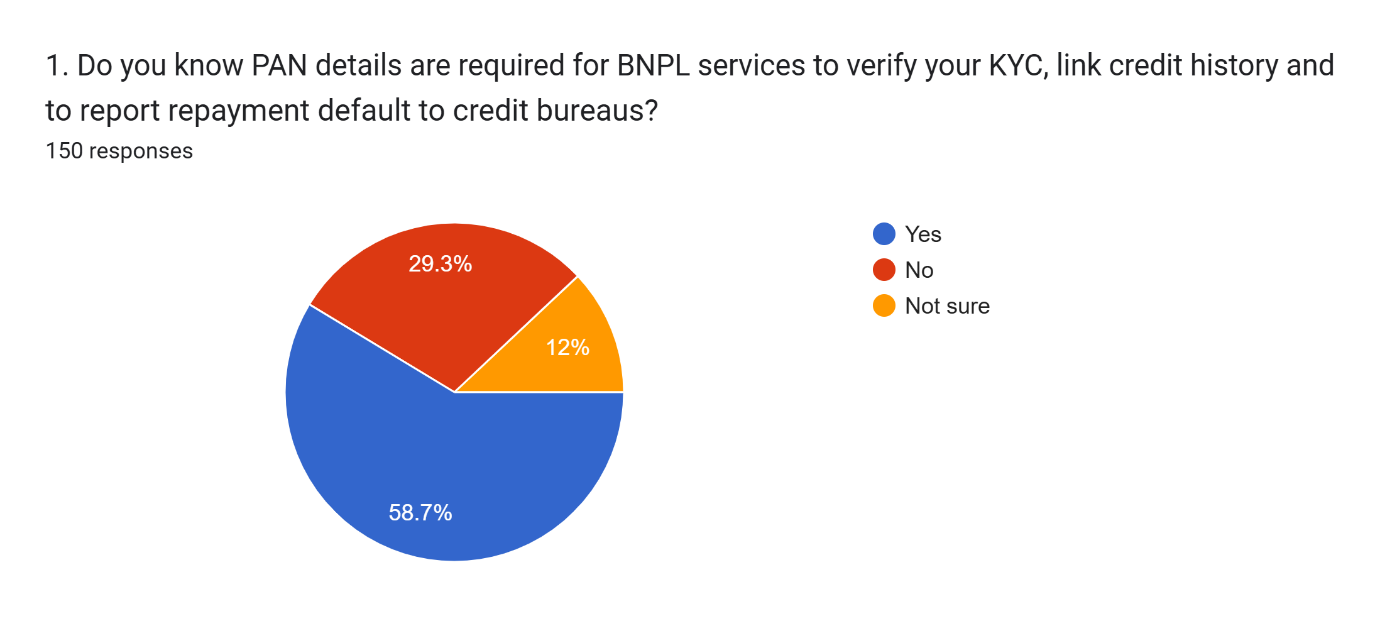
Inference: The majority of respondents (58.7%) are aware that Permanent Account Number (PAN) details are mandatory for BNPL services to verify identity (KYC), connect credit history and report payment information to credit bureaus. However, a significant portion, consisting of those who answered “No” (29.3%) and “Not sure” (12%), totalling 41.3%, lacks definite knowledge of this critical requirement. This lack of awareness among a large segment of users suggests a potential gap in understanding the legal and credit implications associated with using BNPL products. Since PAN details link directly to credit reporting, this knowledge gap means many consumers may be unaware of how BNPL usage affects their financial reputation.
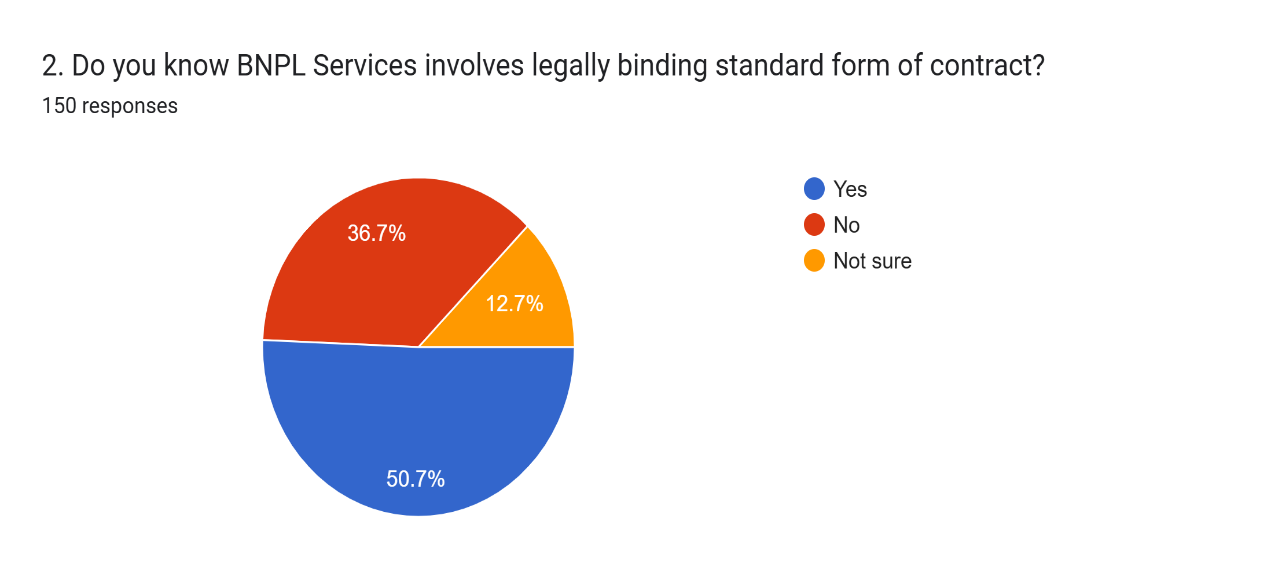
Inference: Just over half of the respondents (50.7%) are aware that utilising BNPL services involves agreeing to a legally binding standard form contract. Conversely, a substantial percentage of the surveyed population, nearly half (49.4%), indicated that they are either unaware (36.7%) or unsure (12.7%) of the binding legal nature of the BNPL agreement. A large portion of respondents does not recognise that BNPL services involve legally binding standard form contracts. This lack of awareness indicates that users may not appreciate the full legal obligations they undertake when using BNPL services. It raises concerns over potential user negligence regarding contractual terms, which could lead to disputes or defaults.
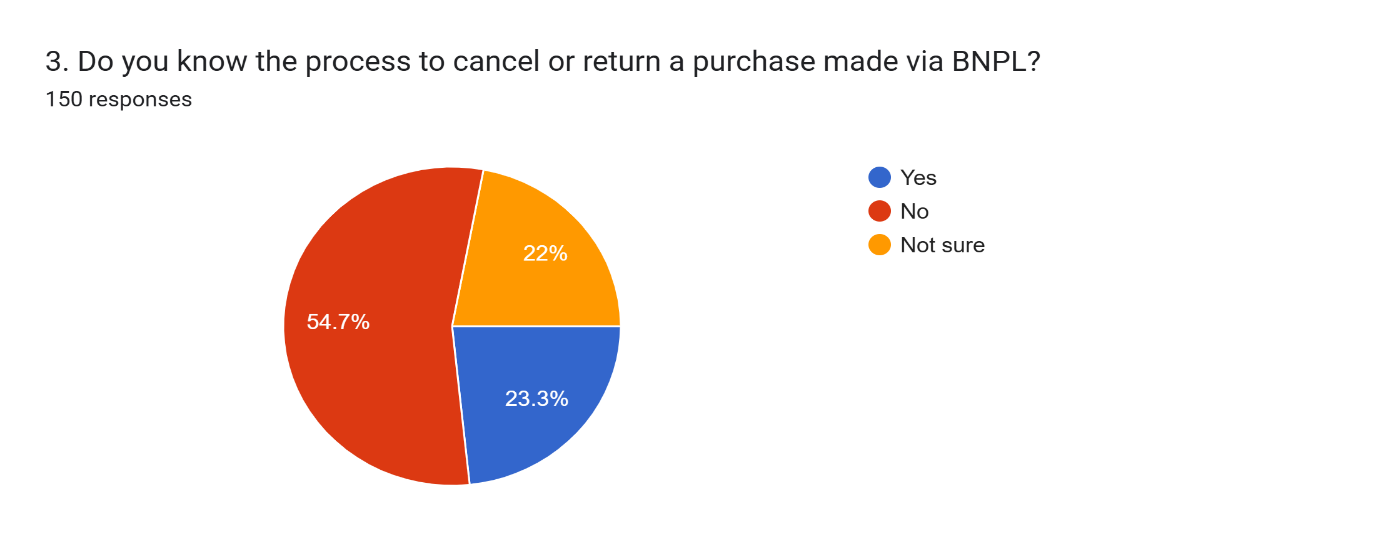
Inference: The results show a significant deficiency in user knowledge of post-purchase procedures, as the majority of respondents (54.7%) do not know the process for cancelling or returning a purchase made using BNPL. When those who are “Not sure” (22%) are included, nearly three-quarters of the surveyed group (76.7%) lack clear knowledge about handling a cancellation. This highlights a lack of transparency and communication on refund policies specific to BNPL transactions. Users who are uninformed about the process might hesitate to use BNPL for fear of complicated returns. Providers and regulators should focus on clarifying these processes upfront to build trust.
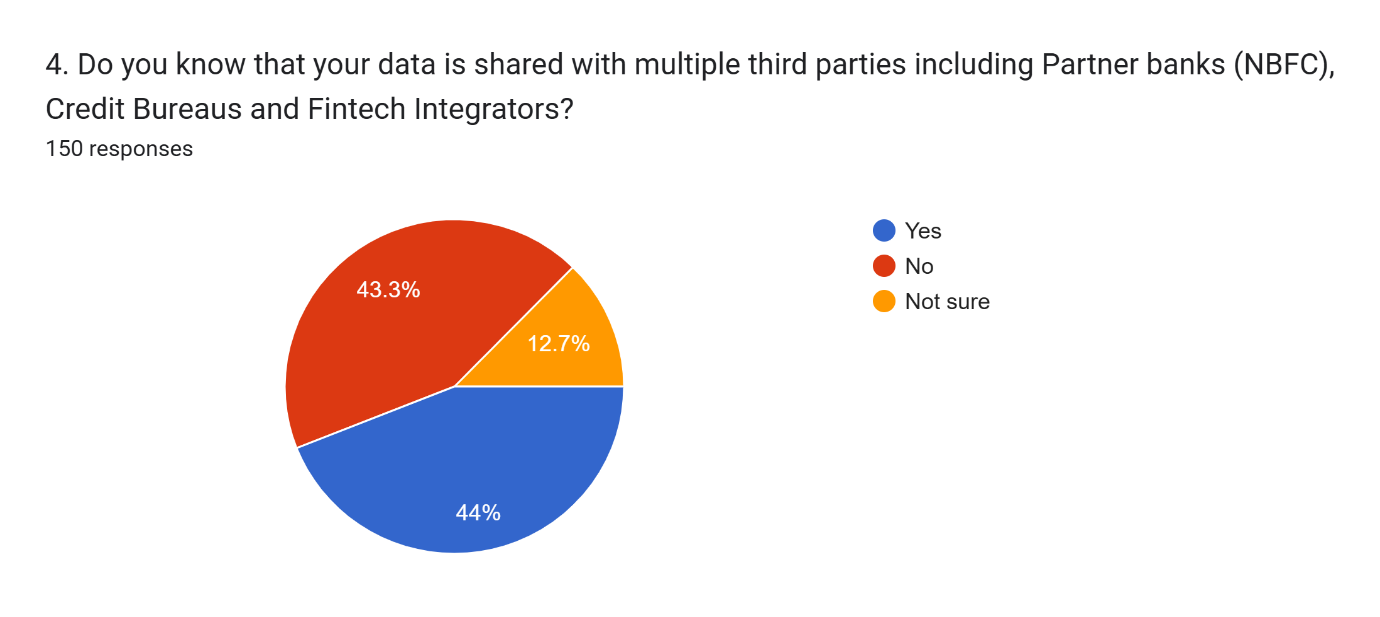
Inference: Knowledge of the extensive sharing of user data with multiple third parties in the BNPL ecosystem, including partner banks, NBFCs, credit bureaus and fintech integrators, is sharply divided. While 44% of respondents reported being aware of this data sharing, a nearly equal percentage (43.3%) were unaware, and 12.7% were unsure. This means that 56% of users are not certain about the scope of data circulation, highlighting a significant gap in transparency regarding data privacy and third-party involvement in BNPL transactions. This low level of awareness raises privacy concerns and questions about informed consent in data handling. Users may be unknowingly exposed to wider data circulation than expected, increasing risks related to data security. Enhancing transparency about data flows can help in strengthening user confidence and regulatory compliance. Education about data sharing practices is crucial.
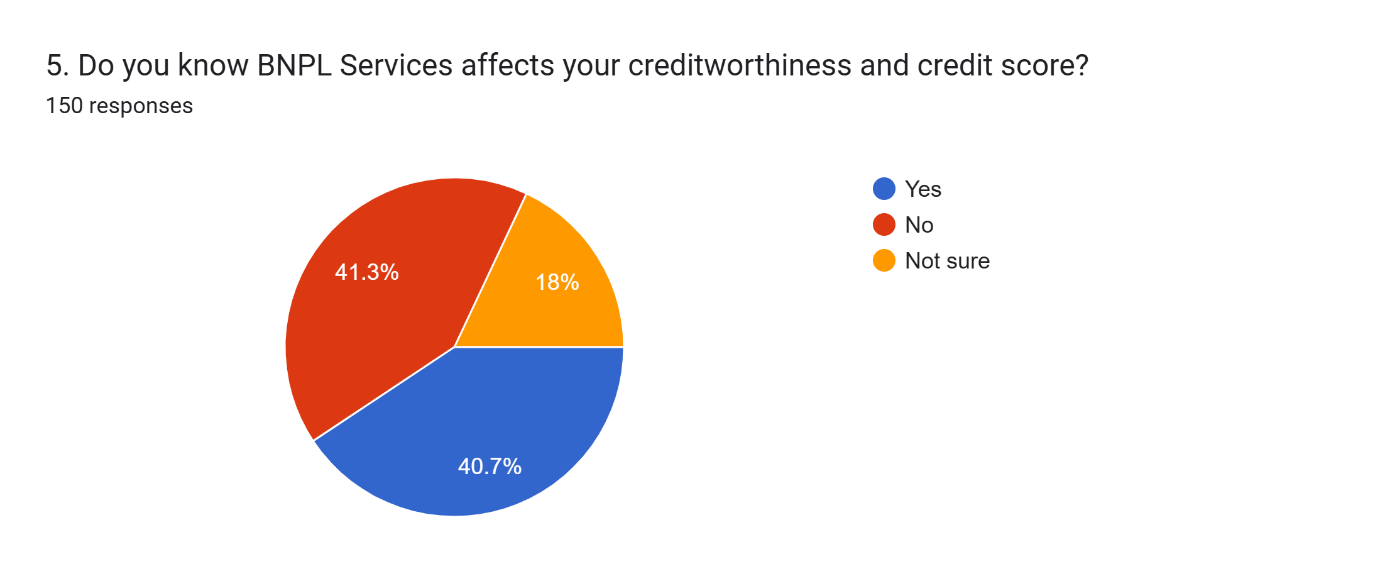
Inference: The survey demonstrates that user knowledge of the impact of BNPL services on creditworthiness and credit scores is highly contested, with 41.3% reporting “No” and 40.7% reporting “Yes”. The combined total of respondents who are unaware or unsure (59.3%) indicates that most consumers lack confirmed knowledge that their use of BNPL could significantly influence their credit standing. This finding is critical because it suggests that a high number of individuals may be using BNPL without understanding the potential financial risk or benefit to their long-term credit profile. This lack of understanding could result in users mishandling BNPL repayments on the assumption that there are no credit consequences. Ignorance of the credit impact may lead to defaults that harm users’ financial profiles without their knowledge.
| Individuals with | High knowledge | Low knowledge | Total |
|---|---|---|---|
| Income between Rs. 1,000 and Rs. 50,000 | 45 | 70 | 115 |
| Income above Rs. 50,000 | 13 | 22 | 35 |
| Total | 58 | 92 | 150 |
Table II: Calculation of χ² for knowledge: contingency table
For individuals with an income between Rs. 1,000 and Rs. 50,000, the expected value (E) = (row total for the row of that cell × column total for the column of that cell) / grand total. High knowledge: (58 × 115) / 150 = 44.46. Low knowledge: (92 × 115) / 150 = 70.53.
For individuals with an income above Rs. 50,000, the expected value (E) = (row total for the row of that cell × column total for the column of that cell) / grand total. High knowledge: (58 × 35) / 150 = 13.53. Low knowledge: (92 × 35) / 150 = 21.46.
| Income group | Category | Observed value (O) | Expected value (E) | O − E | (O − E)² | (O − E)² / E |
|---|---|---|---|---|---|---|
| Rs. 1,000 to Rs. 50,000 | High knowledge | 45 | 44.46 | 0.54 | 0.2916 | 0.0065 |
| Low knowledge | 70 | 70.53 | -0.53 | 0.2809 | 0.0039 | |
| Above Rs. 50,000 | High knowledge | 13 | 13.53 | -0.53 | 0.2809 | 0.0207 |
| Low knowledge | 22 | 21.46 | 0.54 | 0.2916 | 0.0135 | |
| Total | 0.0446 |
Table III: Calculation of χ² for knowledge
Chi-square (χ²): χ² = Σ (Oᵢ − Eᵢ)² / Eᵢ. Degrees of freedom: (r − 1)(c − 1) = (2 − 1)(2 − 1) = (1)(1) = 1. The table value of chi-square (χ²) for 1 degree of freedom at the 5% level of significance is 3.841. The calculated value of χ² is 0.0446, which is less than the table value.
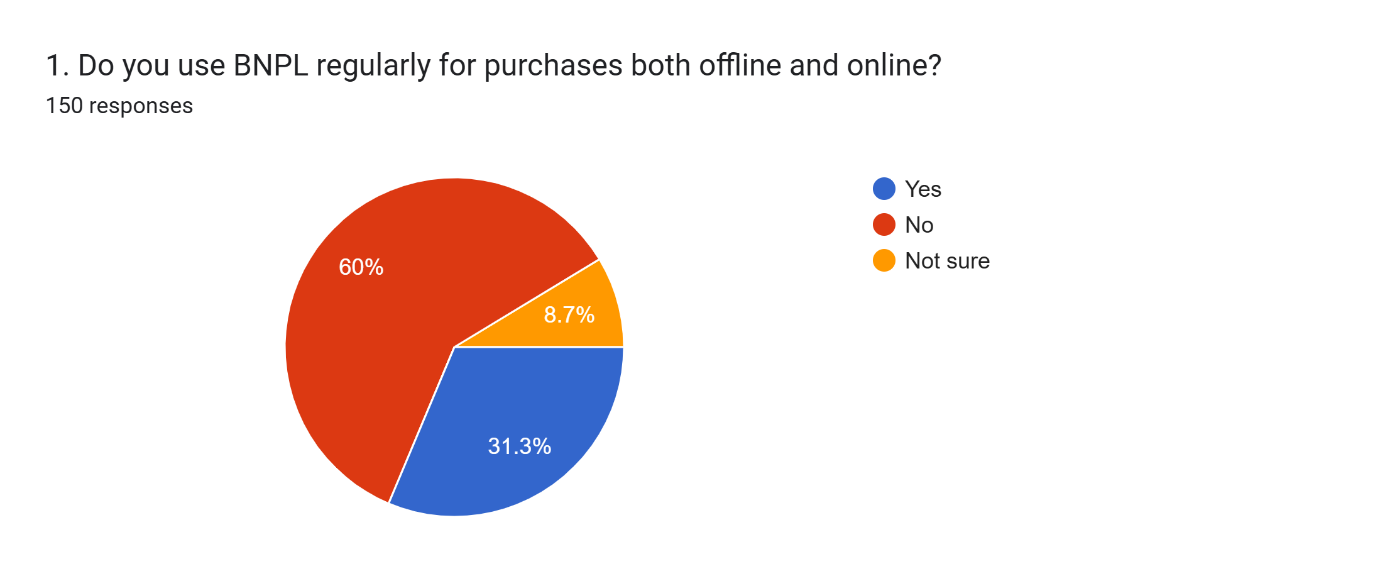
Inference: The majority of respondents (60%) reported that they do not use BNPL services regularly for purchases across both offline and online channels. Despite the sector’s rapid growth, only 31.3% categorise themselves as regular BNPL users. This suggests that BNPL, while adopted by a notable segment, is not yet a primary or habitual payment method for most of the surveyed population. Only a minority of respondents report regular use of BNPL for both online and offline purchases. This limited engagement suggests that BNPL is still an emerging payment method for many users. Users may prefer traditional payment methods or might be hesitant about the risks or obligations of BNPL services. The low usage rate reflects potential market opportunities but also indicates the need for confidence-building through better product features and education. Convenience and trust factors could drive increased adoption.
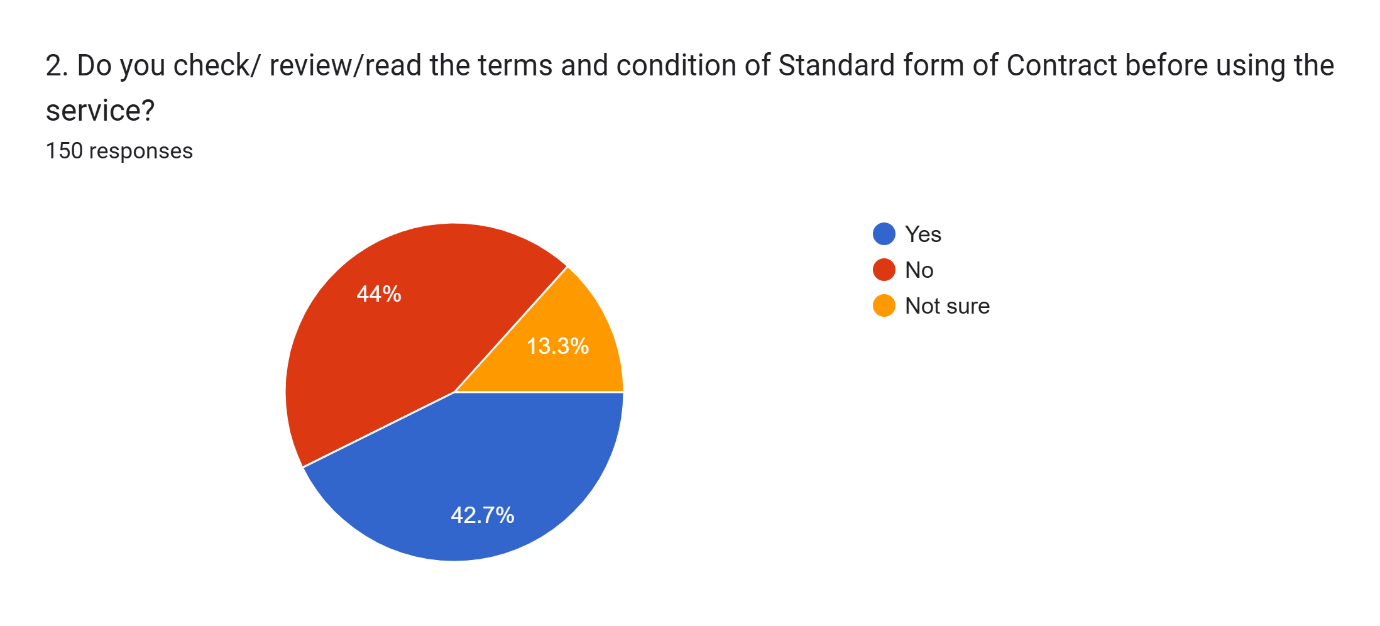
Inference: A slight plurality of respondents (44%) admitted to not checking, reviewing or reading the terms and conditions of the standard form contract before utilising BNPL services. When coupled with the 13.3% who are “Not sure”, over half of the users (57.3%) are entering into these legally binding contracts without due diligence or full comprehension of the terms. This behaviour suggests that consumers prioritise convenience over scrutinising complex contractual documentation. Most users do not frequently check or carefully read the terms and conditions (standard contracts) before using BNPL services. This neglect reveals a passive approach to understanding their contractual rights and responsibilities. It raises the risk of surprises related to fees, penalties or other contractual clauses. This behaviour points to either complexity or poor communication of terms, discouraging thorough user review. Simplifying terms and proactive disclosure could improve transparency and user engagement.
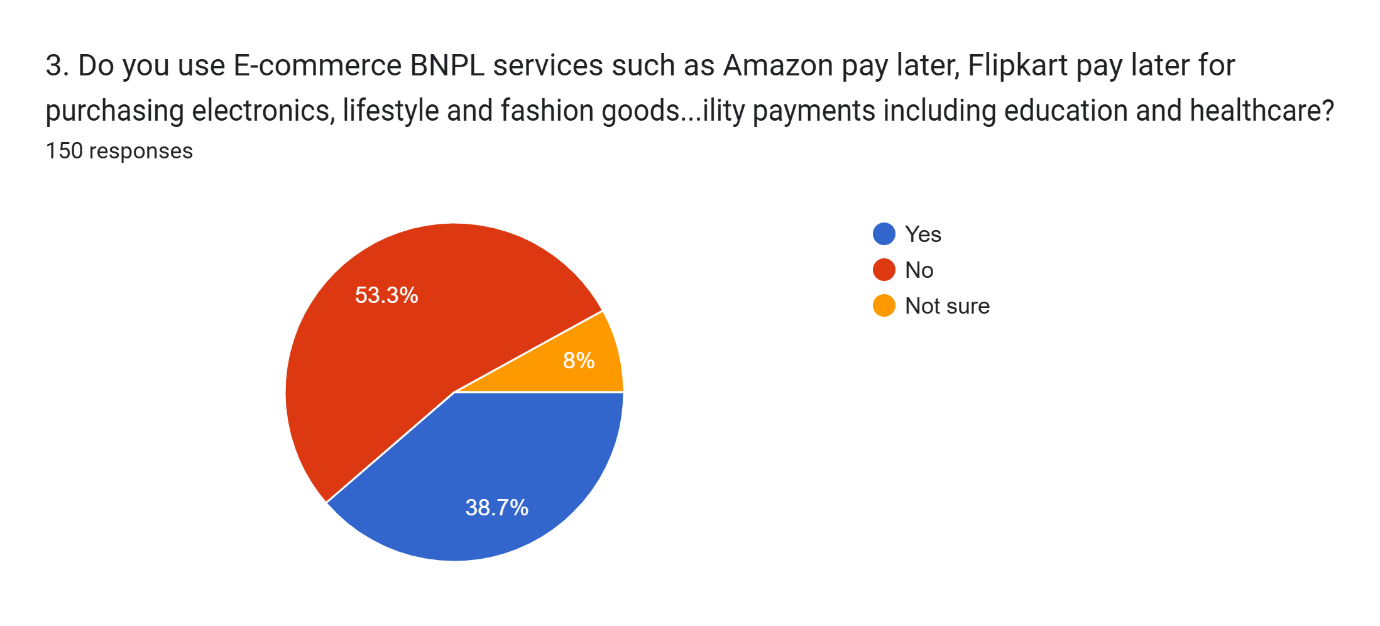
Inference: While a majority (53.3%) stated that they do not use e-commerce BNPL services for categories such as electronics, fashion, education and healthcare payments, a substantial minority (38.7%) confirmed utilising them. The high “No” response suggests that alternative payment methods remain dominant for essential payments and high-value categories among the majority. However, the 38.7% usage rate confirms that BNPL has successfully integrated into major e-commerce platforms for these specific consumer segments. It reflects the marketing and availability focus of BNPL providers in the e-commerce sphere. This trend might limit BNPL’s broader adoption in crucial sectors like healthcare or education without targeted outreach.
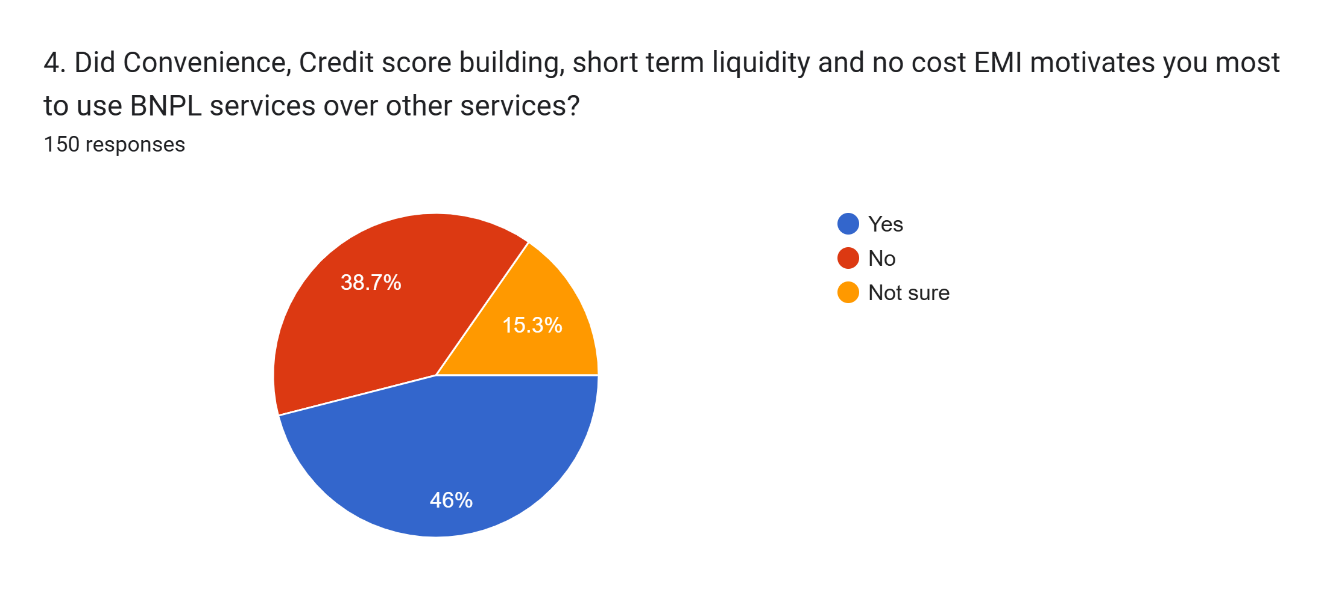
Inference: Collectively, the factors of convenience, credit score building, short-term liquidity and no-cost EMI are the primary motivations for 46% of respondents using BNPL services. However, a substantial number (38.7%) stated that these factors were not their main motivators, implying that other underlying needs or external pressures may drive their usage. The fact that these key marketed advantages do not motivate nearly 40% of users suggests that a broader range of reasons influences BNPL adoption. Users appreciate how BNPL can ease cash-flow concerns while potentially improving credit profiles when repayments are timely. These positive motivations demonstrate BNPL’s appeal but also imply user expectations for clear and fair terms to sustain adoption. Misalignment between expectations and realities could decrease trust.
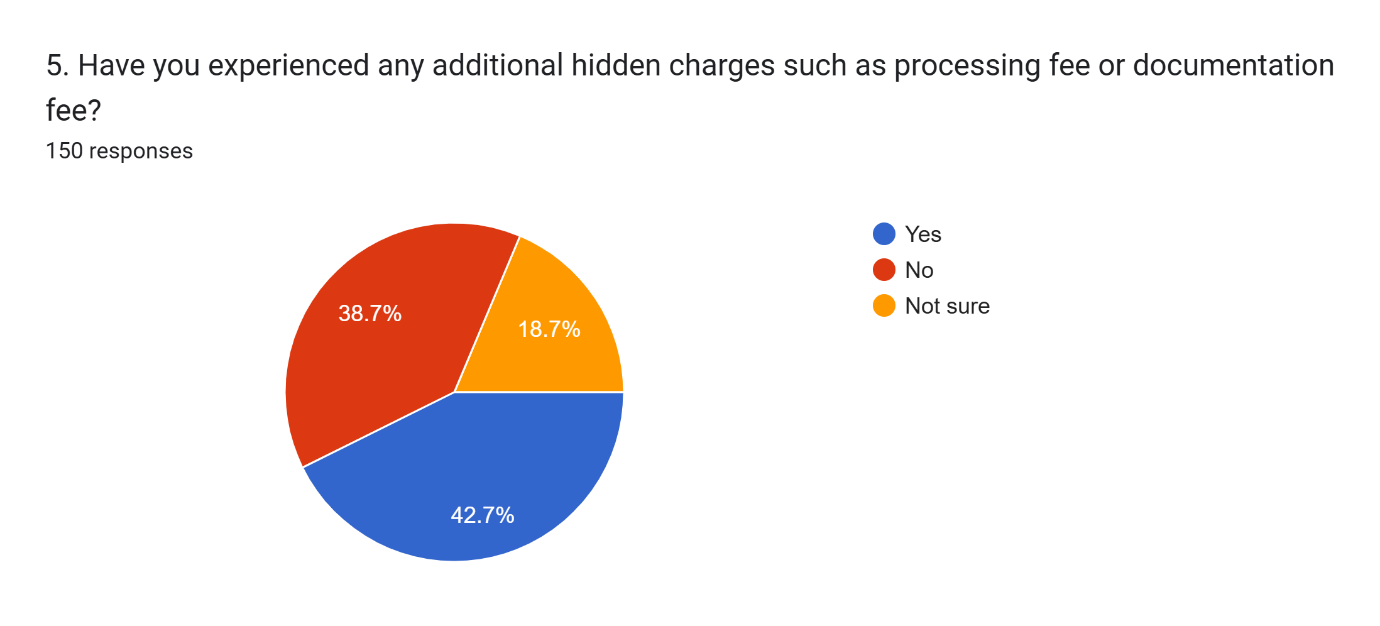
Inference: A plurality of respondents (42.7%) reported experiencing additional hidden charges, such as processing or documentation fees, when using BNPL services. This figure is higher than the percentage who reported no such experience (38.7%), indicating that a large proportion of the user base encounters fee structures perceived as non-transparent or concealed. This prevalence of perceived hidden fees highlights a significant potential transparency issue that could undermine consumer trust in BNPL providers. Hidden fees may act as deterrents and contribute to negative user experiences and reputational risks for BNPL schemes. Transparency and upfront disclosure of all charges are essential to mitigate dissatisfaction. Regulators might consider enforcing clearer pricing norms.
| Individuals with | High involvement | Low involvement | Total |
|---|---|---|---|
| Income between Rs. 1,000 and Rs. 50,000 | 37 | 78 | 115 |
| Income above Rs. 50,000 | 14 | 21 | 35 |
| Total | 51 | 99 | 150 |
Table IV: Calculation of χ² for involvement: contingency table
For individuals with an income between Rs. 1,000 and Rs. 50,000, the expected value (E) = (row total for the row of that cell × column total for the column of that cell) / grand total. High involvement: (51 × 115) / 150 = 39.10. Low involvement: (99 × 115) / 150 = 75.90.
For individuals with an income above Rs. 50,000, the expected value (E) = (row total for the row of that cell × column total for the column of that cell) / grand total. High involvement: (51 × 35) / 150 = 11.90. Low involvement: (99 × 35) / 150 = 23.10.
| Income group | Category | Observed value (O) | Expected value (E) | O − E | (O − E)² | (O − E)² / E |
|---|---|---|---|---|---|---|
| Rs. 1,000 to Rs. 50,000 | High involvement | 37 | 39.10 | -2.1 | 4.41 | 0.112 |
| Low involvement | 78 | 75.90 | 2.1 | 4.41 | 0.058 | |
| Above Rs. 50,000 | High involvement | 14 | 11.90 | 2.1 | 4.41 | 0.370 |
| Low involvement | 21 | 23.10 | -2.1 | 4.41 | 0.190 | |
| Total | 0.73 |
Table V: Calculation of χ² for involvement
Chi-square (χ²): χ² = Σ (Oᵢ − Eᵢ)² / Eᵢ. Degrees of freedom: (r − 1)(c − 1) = (2 − 1)(2 − 1) = (1)(1) = 1. The table value of chi-square (χ²) for 1 degree of freedom at the 5% level of significance is 3.841. The calculated value of χ² is 0.73, which is less than the table value.
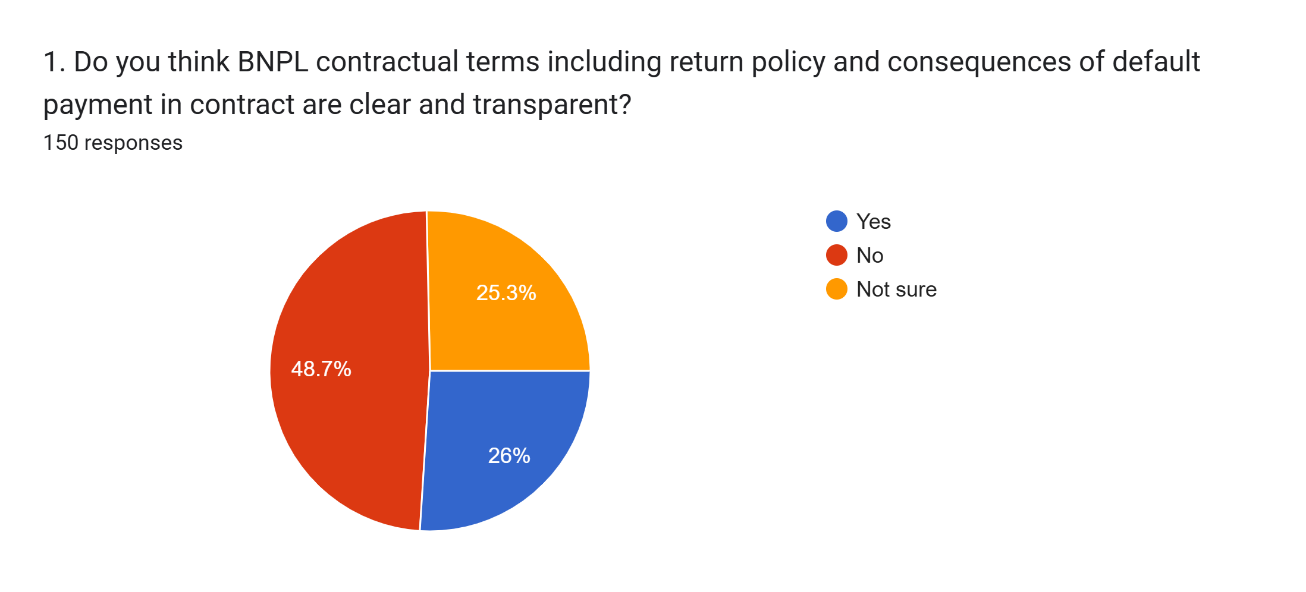
Inference: The results show significant dissatisfaction with contract transparency, as 48.7% explicitly stated that they do not think BNPL contractual terms, including return policies and default consequences, are clear and transparent. When combined with the “Not sure” segment (25.3%), nearly three-quarters of users (74%) lack confidence in the clarity of the agreements. This strong negative assessment points to a critical systemic failure in communicating essential information regarding policies and penalties to the consumer. Lack of clarity could increase disputes and defaults, as users might misunderstand their rights and obligations. Clear, concise and user-friendly terms are needed to foster trust and compliance. Improving contract transparency could reduce friction in BNPL adoption.
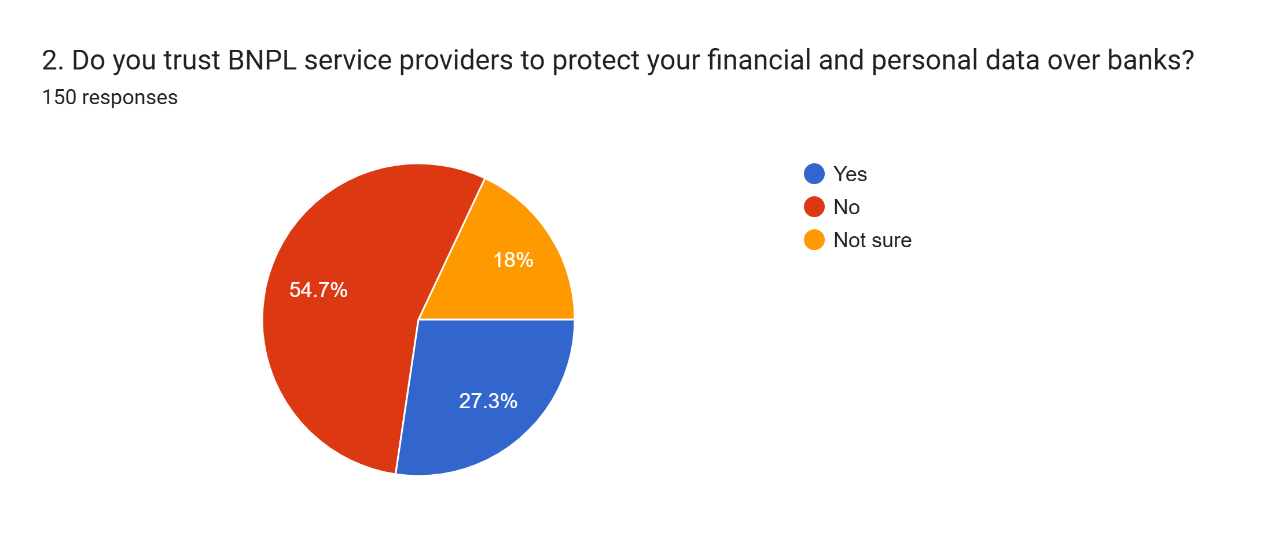
Inference: Trust in BNPL providers to protect financial and personal data is noticeably low, with 54.7% of respondents indicating that they do not trust BNPL providers more than banks. Only 27.3% expressed greater confidence in BNPL providers for data security. This low level of comparative trust suggests widespread concern among consumers regarding the data-protection capabilities and practices of newer fintech services compared with established banking institutions. Users show lower trust in BNPL service providers’ ability to protect their personal and financial data than in traditional banks. This lack of confidence may arise from lesser-known BNPL firms or past data breaches in fintech. Trust deficits could slow BNPL adoption and drive users to prefer more established financial institutions. BNPL companies must prioritise and communicate robust data protection practices to build consumer confidence. Regulatory oversight and certifications might also enhance trustworthiness.
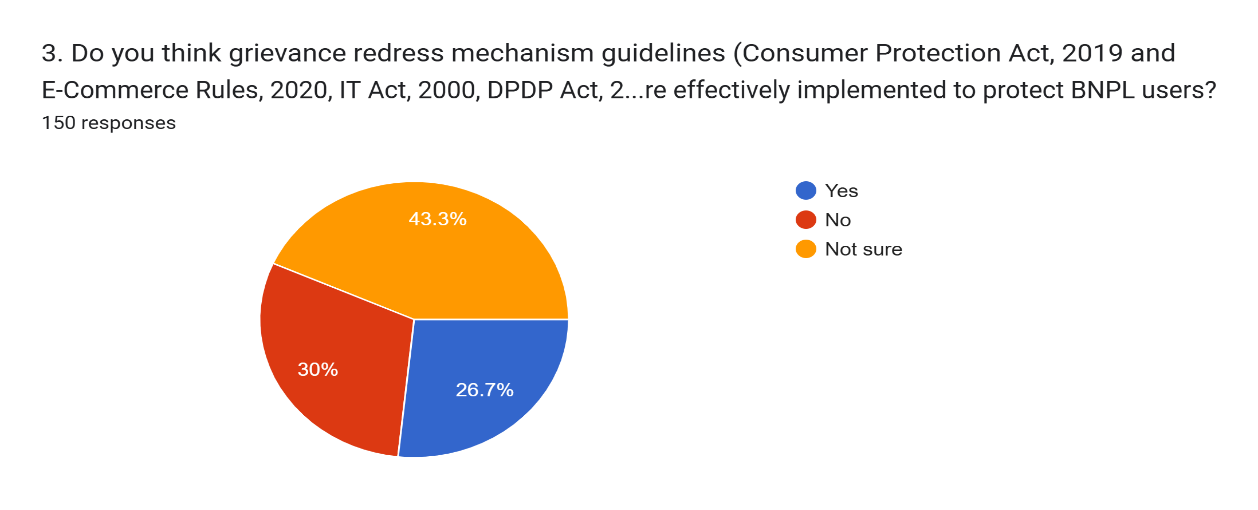
Inference: When asked about the effective implementation of grievance redress mechanisms (such as those mandated by the Consumer Protection Act and the E-Commerce Rules) to protect BNPL users, the largest percentage (43.3%) responded “Not sure”. While 30% reported “No” (indicating perceived ineffectiveness), the overwhelming uncertainty suggests that most users are unaware of, or have not had sufficient access to, robust and clearly effective protection and redress systems. The high “Not sure” rate implies that the consumer-protection infrastructure might not be sufficiently visible or straightforward for the average BNPL user. Most respondents feel that the grievance redress mechanisms under the relevant laws (the Consumer Protection Act, 2019, the E-Commerce Rules, 2020, the Information Technology Act, 2000, the DPDP Act, 2023 and the Contract Act, 1872) are ineffectively implemented to protect BNPL users. This concern implies difficulties in resolving disputes, appeals or complaints associated with BNPL services. Ineffective mechanisms can discourage users from adopting BNPL because of a perceived lack of recourse. Strengthening awareness, accessibility, and enforcement of grievance processes is critical for consumer protection. Improved regulatory focus on BNPL-specific issues may help.
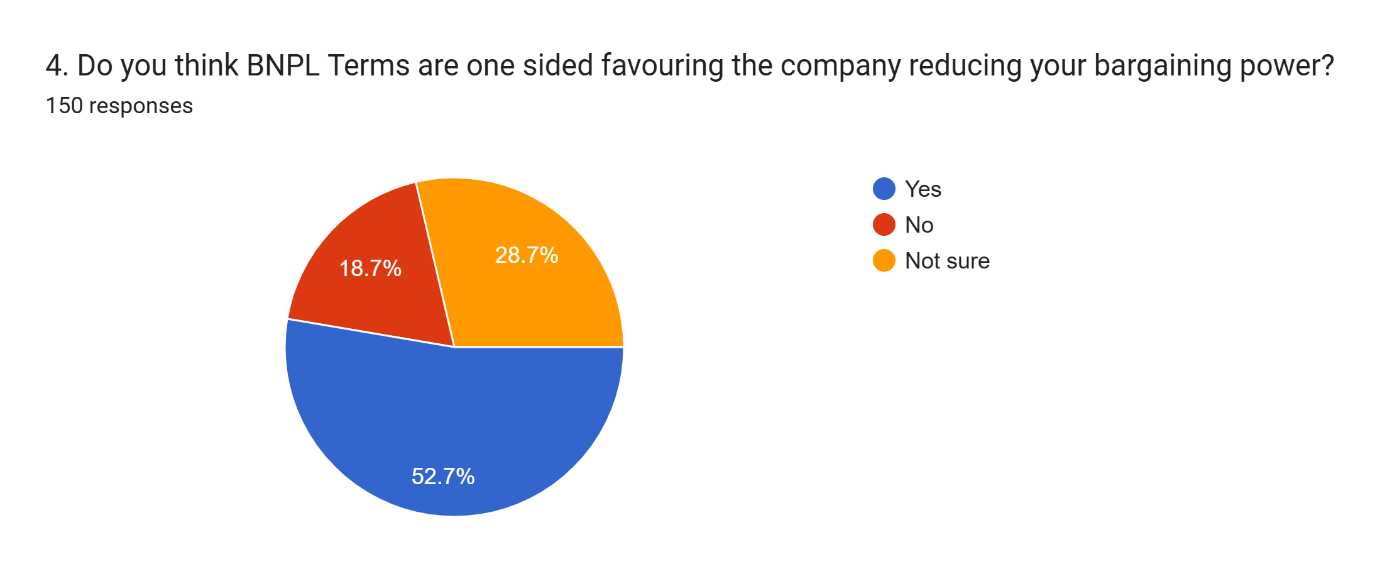
Inference: A clear majority of respondents (52.7%) believe that BNPL terms are one-sided, disproportionately favouring the company and thereby diminishing the consumer’s bargaining power. This strong perception of imbalance confirms the user sentiment that they hold minimal negotiating leverage when accepting these standard contracts. This overwhelming agreement on the one-sided nature of the terms underscores potential issues of fairness and equity in the BNPL contractual relationship. There is a strong perception that BNPL terms favour the provider, reducing bargaining power for users. Unbalanced contract provisions could include punitive penalties, restricted returns, or limited user rights. This imbalance undermines fair treatment and may lead to user exploitation or dissatisfaction.
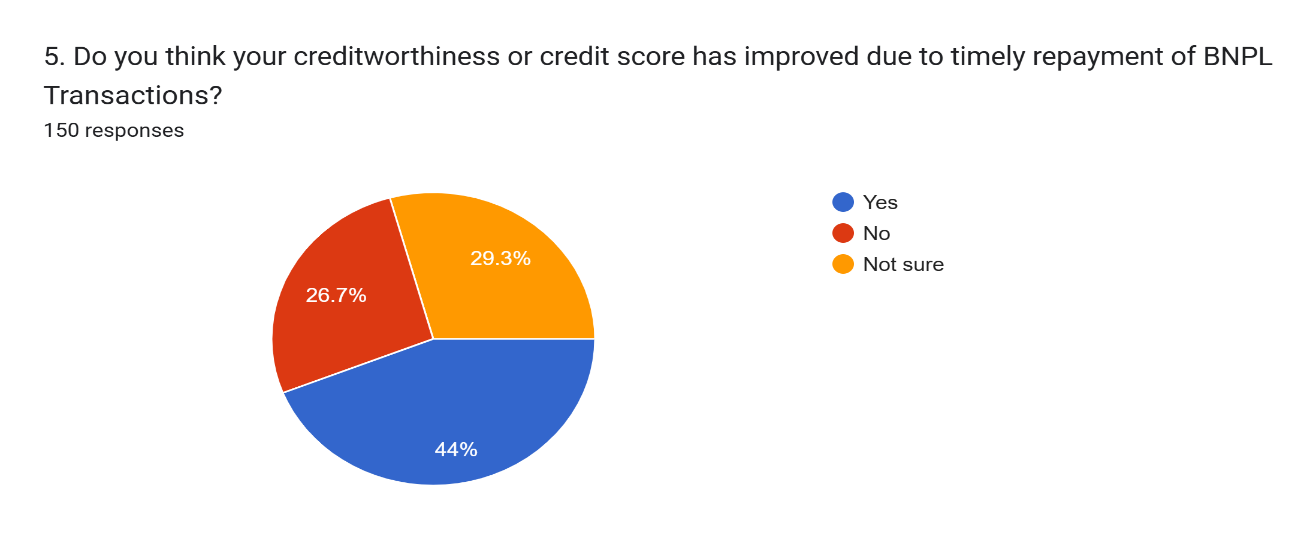
Inference: A plurality of respondents (44%) reported a positive outcome, believing that their creditworthiness or credit score had improved as a result of timely BNPL repayments. This suggests that many consumers recognise and experience BNPL as a valuable tool for building a credit history when managed responsibly. However, a significant portion (29.3%) was “Not sure” about the impact, indicating that the feedback loop or visibility of credit-score changes after repayment is not uniform or clear for all users. Some users report that timely repayment of BNPL transactions has positively affected their credit scores and overall creditworthiness. This feedback suggests that BNPL can serve as a tool for building or repairing credit when managed responsibly. It reveals a constructive side of BNPL use that benefits consumers financially by demonstrating credit discipline. Promoting this feature could attract more users seeking credit enhancement. Educational efforts might focus on aligning repayment behaviour with credit benefits.
| Individuals with | High assessment | Low assessment | Total |
|---|---|---|---|
| Income between Rs. 1,000 and Rs. 50,000 | 29 | 86 | 115 |
| Income above Rs. 50,000 | 12 | 23 | 35 |
| Total | 41 | 109 | 150 |
Table VI: Calculation of χ² for assessment: contingency table
For individuals with an income between Rs. 1,000 and Rs. 50,000, the expected value (E) = (row total for the row of that cell × column total for the column of that cell) / grand total. High assessment: (41 × 115) / 150 = 31.43. Low assessment: (109 × 115) / 150 = 83.56.
For individuals with an income above Rs. 50,000, the expected value (E) = (row total for the row of that cell × column total for the column of that cell) / grand total. High assessment: (41 × 35) / 150 = 9.56. Low assessment: (109 × 35) / 150 = 25.43.
| Income group | Category | Observed value (O) | Expected value (E) | O − E | (O − E)² | (O − E)² / E |
|---|---|---|---|---|---|---|
| Rs. 1,000 to Rs. 50,000 | High assessment | 29 | 31.43 | -2.43 | 5.904 | 0.187 |
| Low assessment | 86 | 83.56 | 2.44 | 5.953 | 0.071 | |
| Above Rs. 50,000 | High assessment | 12 | 9.56 | 2.44 | 5.953 | 0.622 |
| Low assessment | 23 | 25.43 | -2.43 | 5.904 | 0.232 | |
| Total | 1.112 |
Table VII: Calculation of χ² for assessment
Chi-square (χ²): χ² = Σ (Oᵢ − Eᵢ)² / Eᵢ. Degrees of freedom: (r − 1)(c − 1) = (2 − 1)(2 − 1) = (1)(1) = 1. The table value of chi-square (χ²) for 1 degree of freedom at the 5% level of significance is 3.841. The calculated value of χ² is 1.112, which is less than the table value.
| Section | Calculated χ² | Table value (df = 1, p = 0.05) | Hypothesis outcome |
|---|---|---|---|
| Knowledge | 0.0446 | 3.841 | Less than the table value |
| Involvement | 0.73 | 3.841 | Less than the table value |
| Assessment | 1.112 | 3.841 | Less than the table value |
Table VIII: Summary of chi-square results
Mean value = (0.0446 + 0.73 + 1.112) / 3 = 0.628.
Hypothesis testing: Since all the calculated χ² values (0.0446, 0.73 and 1.112) are less than the critical table value of 3.841 at 1 degree of freedom (5% level of significance), we fail to reject H₀. This indicates that there is no statistically significant association between income group and BNPL users’ knowledge, involvement or assessment levels.
The Consumer Protection Act, 2019 represents a major step forward for India, particularly in a fast-changing financial landscape. As consumer transactions have become more modern and intricate, the Act was enacted to ensure that consumer interests are well guarded in an increasingly digital age. A standout feature of the 2019 Act is its broadened definition of “consumer”, which now encompasses anyone making online purchases through e-commerce platforms. Moreover, the Act established the Central Consumer Protection Authority (CCPA), which plays a vital role in defending consumer rights. This authority is empowered to investigate issues and handle complaints, ensuring that consumers have a dependable resource for support.6
Unfair trade practices cover matters such as deceptive advertisements, false claims and the failure to provide bills or receipts for goods and services. Buy Now Pay Later services are classified as “services” under the Act, since they allow for deferred payment.7
The Consumer Protection Act, 2019 defines an “unfair contract”8 as one that imposes:
1. excessive security deposits as a requirement from consumers;
2. unreasonably high penalties for breach of contract;
3. unilateral modifications by manufacturers, traders or service providers;
4. restrictions on consumers’ rights to sue or seek legal remedies; and
5. disproportionate obligations on consumers.
Representing a BNPL product as “zero cost”, “interest-free” or “free” may constitute an unfair trade practice under Section 2(47)9 where the representation conceals processing fees, documentation charges, late-payment penalties, auto-debit failure fees, convenience charges or other mandatory costs. Digital lending and BNPL agreements are commonly presented through standard-form contracts that consumers accept without negotiation. Such terms may attract scrutiny under Section 2(46) of the Act where they create a significant imbalance in the parties’ rights and obligations or impose unreasonable charges, obligations or conditions to the consumer’s disadvantage. The statutory definition expressly includes unreasonable charges and conditions that place the consumer at a disadvantage. Section 2(9) of the Act recognises the consumer’s right to be informed about the quality, quantity, potency, purity, standard and price of goods or services.10 In the context of digital credit, this right should be interpreted in a manner appropriate to the nature of the service. It includes meaningful information concerning the price and principal conditions of the credit facility, rather than disclosure that is technically available but practically unintelligible.
Accordingly, a failure to explain the repayment schedule, total repayment obligation, applicable fees, default consequences, credit-bureau reporting and data-sharing implications may deprive consumers of the information necessary to make an informed financial decision. Such omissions may operate independently as a consumer-protection violation and may also reinforce a claim that the platform’s representations were deceptive.
The Consumer Protection (E-Commerce) Rules, 2020,11 while not specifically designed for BNPL services, still play a crucial role in regulating BNPL models that operate within e-commerce. These rules place certain responsibilities on e-commerce entities, marketplaces and sellers that offer BNPL as a payment option. For instance, BNPL providers that are part of e-commerce platforms must ensure that pricing is clear, total costs are transparent, and refund or return policies are straightforward.
In India, the Reserve Bank of India (RBI) regulates Payment System Operators (PSOs) under the Payment and Settlement Systems Act, 2007 (PSS Act). No person other than the Reserve Bank can operate or commence a payment system unless authorised by the Reserve Bank.12 The RBI’s role is to authorise and supervise PSOs, ensuring that they adhere to security protocols and anti-money-laundering laws. PSOs are the entities that run and manage payment systems, enabling the transfer of funds between individuals, businesses and financial institutions.
The RBI has directed the Bengaluru-based BNPL start-up Simpl to halt all payment operations immediately, as it lacked the necessary authorisation under the PSS Act. The news was first reported by The Economic Times. In a letter dated September 25, 2025, the regulator informed Simpl that it must stop all activities related to payment systems, including payment, clearing and settlement functions.13
PSOs are essential to the smooth functioning of electronic payments. They can be categorised into a few different types:
1. Card networks: these handle debit and credit card payments, such as Visa and Mastercard.
2. UPI-based PSOs: these allow for real-time mobile payments, such as Google Pay and PhonePe.
3. Wallet-based PSOs: these manage prepaid wallets, such as Paytm and Amazon Pay.
4. Payment gateways: these facilitate online transactions, such as Razorpay and PayU.
BNPL services are heavily reliant on digital payments and smooth fund transfers. However, regulatory challenges and restrictions on PSOs are starting to affect the BNPL business model. The RBI has barred non-bank prepaid payment instrument (PPI) issuers from loading PPIs through credit lines.14 Most BNPL providers used PPIs to extend credit lines, allowing consumers to make purchases through digital wallets. With these restrictions in place, companies have had to rethink their operational strategies. If PSOs were to impose transaction limits, extra fees or other regulatory hurdles, it could significantly affect the adoption of BNPL services. For example, if Mastercard were to limit transactions related to BNPL, it could make it difficult for BNPL providers to onboard merchants or process payments effectively. On a positive note, there is potential for collaboration between PSOs and BNPL providers, which could lead to seamless embedded credit solutions. For instance, ZestMoney partnered with Razorpay, and Visa is integrating BNPL directly into its merchant payment gateways.
FinTech platforms may fail to satisfy Section 6(1) of the Digital Personal Data Protection Act, 2023 (DPDP Act) when they rely on bundled consent. Consent under the provision must be free, specific, informed, unconditional and unambiguous, and must be signified through clear affirmative action. It must also be limited to the personal data necessary for the specified purpose.15 Accordingly, making access to credit conditional upon consent to unrelated processing, such as marketing, extensive profiling or sharing with non-essential commercial partners, may undermine the voluntariness and specificity of consent. Since Section 6(1) also requires consent to be confined to the personal data necessary for the specified purpose, where algorithms are used to assess credit the legality of collection depends not merely on whether consent was technically obtained, but also on whether the requested data are reasonably necessary for the stated processing activity.16 The disclosure of transaction histories, identity documents, financial profiles and repayment information to NBFCs, credit-information companies, cloud-service providers, collection agencies, analytics firms or other commercial partners requires transparent disclosure of the relevant processing arrangements.17 A general reference to “trusted partners” may be insufficient where it does not meaningfully identify the categories of recipients, the purposes of disclosure and the nature of the processing undertaken. The platform should provide a clear and accessible notice identifying, at a minimum: the categories of personal data collected and the specific purposes for which each category is processed; the categories of third parties receiving the data; whether the recipient acts as a processor, lender, credit-information company or independent data fiduciary; the applicable retention period or retention criteria; and the procedure for exercising data-principal rights.
A failure to provide such information may impair the data principal’s ability to make an informed choice and may indicate inadequate compliance with the transparency and accountability obligations imposed upon the data fiduciary.
The DPDP framework also recognises rights relating to access to information, correction, completion, updating, erasure and grievance redressal, subject to statutory exceptions and legally required retention.18 The right to erasure does not necessarily require the immediate deletion of every financial record. Personal data may need to be retained where retention is necessary for legal compliance, accounting, fraud prevention, dispute resolution, regulatory reporting or other legally recognised purposes. Nevertheless, once the relevant purpose has been fulfilled and no valid retention obligation remains, a platform should not retain personal financial information indefinitely or continue using it for unrelated commercial purposes.19 For instance, obtaining blanket consent through bundled terms and conditions or pre-ticked checkboxes will no longer suffice. Additionally, with new restrictions on cross-border data transfers and the requirement to appoint data protection officers in certain situations, many BNPL companies, especially those with foreign investment or data-processing operations outside India, will need to rethink their organisational and operational frameworks.
The Credit Information Companies (Regulation) Act, 2005 (CICRA) plays a crucial role in overseeing credit information companies (CICs) in India. Its main goal is to ensure that credit institutions, such as banks and non-banking financial companies (NBFCs), can distribute credit efficiently. The Act requires CICs to collect, process and share important credit information, including details of loans, securities, guarantees and the creditworthiness of borrowers, with specified users such as regulated entities. Algorithmic credit-scoring assessments raise concerns about the accuracy and reliability of the data collected, in tension with Section 21, which mandates the correction and updating of credit information upon verification.20 Other concerns include bias and a lack of transparency in automated decision-making. In June 2026, the RBI issued its Draft Guidance on Regulatory Principles for Model Risk Management, 2026. The 2026 draft builds upon two earlier RBI documents: the August 2024 Draft Regulatory Principles for Management of Model Risks in Credit and the August 2025 report of the Committee on the Framework for Responsible and Ethical Enablement of Artificial Intelligence (FREE-AI). Unlike the earlier framework, which focused primarily on credit-risk models, the 2026 draft broadens its scope to cover all models used by regulated entities (REs) across business operations and decision-making processes, including third-party models as well as artificial intelligence and machine learning (AI/ML) models.21
The Reserve Bank of India (Digital Lending) Directions, 2025, which consolidate and replace the Guidelines on Digital Lending of 2022, represent a fundamental redesign of digital credit in India, focusing heavily on consumer dignity, transparency and the elimination of predatory fintech practices.22 Under these directions, lenders must disclose an all-inclusive Annual Percentage Rate (APR) within a standardised Key Fact Statement (KFS); if a fee is not explicitly documented in the KFS, it cannot be recovered from the borrower. Furthermore, a strict direct-disbursement rule mandates that funds must flow directly from the bank’s or NBFC’s account to the borrower’s account without passing through third-party Lending Service Provider (LSP) pool accounts, and any fees payable to LSPs must be paid by the lender rather than deducted from the borrower.23
No significant relationship exists between the income groups in terms of BNPL creditworthiness metrics. Uniformly low awareness and similar behaviours across the groups suggest that BNPL outcomes are driven more by systemic factors such as poor disclosure than by income, which aligns with the RBI’s concerns about universal over-indebtedness risks. Lower-income users show repayment perceptions similar to those of higher earners, implying that alternative underwriting equalises access but heightens vulnerability in the absence of tailored limits.
The empirical study conducted among 150 BNPL users examined the relationship between legal knowledge, financial literacy, consumer experience, regulatory awareness, privacy concerns and creditworthiness in the context of BNPL services in India. The findings reveal that respondents possess a moderate level of legal knowledge and financial literacy, with awareness primarily limited to the operational aspects of BNPL, such as PAN verification and credit reporting, while knowledge of contractual obligations, cancellation policies, data-sharing practices and consumer rights remains comparatively limited.
The survey further indicates that a significant proportion of respondents perceive BNPL contracts as standard-form agreements containing one-sided and non-transparent terms, particularly with respect to repayment obligations, penalty charges and return policies, reflecting concerns about unequal bargaining power between consumers and BNPL providers. In addition, respondents expressed limited confidence in the effectiveness of consumer-protection mechanisms and highlighted concerns about hidden charges, inadequate grievance redressal and insufficient transparency in the implementation of the RBI’s digital lending norms and data-protection practices.
The study also found that many respondents are apprehensive about the handling and sharing of their personal and financial information by BNPL providers, indicating growing privacy concerns within the digital lending ecosystem. At the same time, convenience, instant access to short-term credit and flexible repayment options emerged as the primary factors motivating the use of BNPL services, and several respondents perceived timely repayment as contributing positively to their creditworthiness and future access to credit. However, the chi-square analysis for knowledge (χ² = 0.0446), involvement (χ² = 0.730) and assessment (χ² = 1.112) produced values lower than the critical value of 3.841 at the 5% level of significance, indicating no statistically significant association between respondents’ monthly income and their knowledge, involvement or assessment of BNPL schemes. Overall, the empirical findings suggest that BNPL services are widely adopted for their convenience and financial flexibility; however, gaps in legal awareness, contractual transparency, consumer protection and data privacy continue to present significant challenges that require stronger regulatory compliance and enhanced consumer financial literacy. The lack of a single standardised authority also leads to overlapping jurisdictions for grievance redressal. BNPL providers should also ensure strict compliance with the Digital Personal Data Protection Act, 2023 by adopting informed-consent mechanisms, data-minimisation practices and transparent privacy policies for the collection and processing of consumer data.
1. Before checkout, platforms should display an automated affordability score showing whether the consumer’s current debt load makes the BNPL purchase risky. This score should be simple (green, yellow or red) and based on debt-to-income estimates.
2. BNPL providers should restrict data collection to what is necessary for creditworthiness assessment. Prohibiting unnecessary access to contacts, social media and device information prevents privacy violations and discriminatory profiling.
3. Zero-cost claims often mask processing fees, late penalties, interest-equivalent charges and automatic-debit fees, misleading consumers. A plain-language contract and a standardised Key Fact Statement with clear disclosure of all costs should be mandatory.
4. Many BNPL companies lack efficient dispute-resolution processes, leaving consumers with unresolved issues and unfair charges. Bringing BNPL explicitly under the RBI Ombudsman, or a dedicated digital lending ombudsman, would protect consumer interests, and strict timelines for the disposal of grievances must be established.
5. Where automated or algorithmic systems are used to determine credit limits, approval, rejection or risk classification, BNPL providers should provide consumers with a meaningful explanation of the principal factors that affected the decision. Consumers should also have an accessible mechanism to question inaccurate information and seek human review where an automated decision materially affects their access to credit.
*****
1. Kabir Goel, The Rise of Buy Now, Pay Later (BNPL) in India: Are Millennials Falling into a Debt Trap?, 10 Int’l J. Novel Rsch. & Dev. a764 (2025), https://www.ijnrd.org/papers/IJNRD2502083.pdf.
2. Akshay Aravind, Vijay Sanketh Bhandari, S. Pavanaj & Mohammed Sunoosh Beary, Buy Now Pay Later: A Revolution Challenged in India, 8 Int’l J. Rsch. Trends & Innovation 810 (2023), https://www.ijrti.org/papers/IJRTI2304135.pdf.
3. Malini N & Varshini Janardhana, Buy Now, Pay Later: Lifesaver or Debt Traps? A Research into the Legal Uncertainties, Consumer Risks and the Future of FinTech Lending, 4 Int’l J. Rsch. Acad. World 6 (2025), https://academicjournal.ijraw.com/media/post/IJRAW-4-4-2.1.pdf.
4. Andrian Gaju, Buy Now, Pay Later: Drivers and Challenges in Increasing Adoption, 1 Proc. World Conf. on Mgmt., Bus. & Econ. 1 (2025) (Prague Univ. of Econ. & Bus., Czech Republic), https://www.researchgate.net/publication/393452404_Buy_Now_Pay_Later_Drivers_and_Challenges_in_Increasing_Adoption.
5. Ashika, A Study on the Impact of Buy-Now, Pay-Later Payment Models on Consumer Spending Behaviour, 3 MSNIM Mgmt. Rev. 47 (2025), https://msnim.edu.in/documents/1756/5.54-64_DOC-20250623-WA0014..pdf.
6. The Consumer Protection Act, 2019, No. 35, Acts of Parliament, 2019 (India), §§ 2(7), 10, https://ncdrc.nic.in/bare_acts/CPA2019.pdf.
7. The Aware Consumer, Buy Now Pay Later Products Lack Consumer Protection Safeguards; Can Impose High Monetary Costs: Report, Jago Grahak Jago, https://jagograhakjago.com/speakup/buy-now-pay-later-products-lack-consumer-protection-safeguards-can-impose-high-monetary-costs-report/ (last visited Sept. 6, 2026) (summarising Madhu Srinivas & Srikara Prasad, Dvara Research, on the consumer-protection gaps in ten Indian BNPL products).
8. The Consumer Protection Act, 2019, § 2(46).
9. The Consumer Protection Act, 2019, § 2(47).
10. The Consumer Protection Act, 2019, § 2(9).
11. The Consumer Protection (E-Commerce) Rules, 2020, G.S.R. 462(E) (July 23, 2020) (India).
12. The Payment and Settlement Systems Act, 2007, No. 51, Acts of Parliament, 2007 (India), § 4; Reserve Bank of India, Payment and Settlement Systems Act, 2007: FAQs, https://www.rbi.org.in/commonman/English/Scripts/FAQs.aspx?Id=420 (last visited Sept. 6, 2026).
13. Ritu Singh, RBI Orders BNPL Player Simpl to Suspend Payment Operations, CNBC-TV18 (Sept. 26, 2025), https://www.cnbctv18.com/business/finance/rbi-orders-bnpl-player-simpl-to-suspend-payment-operations-19690879.htm.
14. RBI Bars Non Bank PPIs from Loading Credit Lines; Details Here, Business Today (June 21, 2022), https://www.businesstoday.in/latest/economy/story/rbi-bars-non-bank-ppis-from-loading-credit-lines-details-here-338430-2022-06-21 (reporting the RBI’s communication of June 20, 2022 to non-bank PPI issuers that the Master Directions on Prepaid Payment Instruments do not permit loading of PPIs through credit lines).
15. The Digital Personal Data Protection Act, 2023, No. 22, Acts of Parliament, 2023 (India), § 6(1).
16. Rafiya Tabassum, The Rise of Buy Now Pay Later (BNPL) Models in India: Addressing Consumer Protection Challenges in the Digital Credit Ecosystem, 7 Indian J.L. & Legal Rsch. 2912 (2025), https://www.ijllr.com/post/the-rise-of-buy-now-pay-later-bnpl-models-in-india-addressing-consumer-protection-challenges-in-t.
17. Balasubramanyam Gopatipalyam, DPDP Act for E-Commerce in India: What Online Retailers Must Do in 2026?, Bellwether (Mar. 31, 2026), https://bellwetherindia.com/dpdp-act-for-ecommerce-retail-in-2026.
18. The Digital Personal Data Protection Act, 2023, §§ 11-13.
19. Gopatipalyam, supra note 17.
20. The Credit Information Companies (Regulation) Act, 2005, No. 30, Acts of Parliament, 2005 (India), § 21.
21. CorpLawUpdates, RBI Draft Guidance on Model Risk Management 2026: Board-Level MRMF, AI Kill Switches, Kill-Switch Mandates & Third-Party Accountability, Public Comments by July 24 (June 24, 2026), https://www.corplawupdates.in/updates/rbi-draft-guidance-model-risk-management-2026-ai-ml-banks-nbfcs.
22. Reserve Bank of India, Reserve Bank of India (Digital Lending) Directions, 2025, RBI/2025-26/36 DOR.STR.REC.19/21.07.001/2025-26 (May 8, 2025), https://www.rbi.org.in/scripts/NotificationUser.aspx?Id=12848&Mode=0.
23. Anuj Anand Malik, 7 New RBI Rules Every Borrower Must Know Before Taking a Digital Loan in 2026, AMA Legal Solutions (Apr. 1, 2026), https://www.amalegalsolutions.com/blog/7-new-rbi-rules-digital-loans-2026.