
Introduction
Although they carry distinct definitions, insolvency and bankruptcy are related financial concepts. In the legal sense, insolvency refers to a state of financial crisis in which a company or an individual is unable to pay its debts, whereas bankruptcy is the legal process through which individuals and companies that are unable to pay their creditors seek discharge from some or all of the debts due. The insolvency space is of particular value to the economy: with every transaction it acquires depth, maturity and richness. An effective bankruptcy procedure is one that assists debtors and creditors in determining whether a firm in insolvency is experiencing financial as well as business collapse; this is crucial for enabling both parties to realise the full worth of the company.
To achieve this goal of an equitable balance between the rights of creditors and debtors, a well-structured insolvency procedure is required. The laws that preceded the Code were inadequate and lacked uniformity. The IBC was drafted as an attempt to consolidate and integrate the insolvency laws. The Code acts as an umbrella legislation for insolvency procedures and repeals the Presidency Towns Insolvency Act, 1909 and the Provincial Insolvency Act, 1920, laws which had become outdated and had failed to resolve the issues arising before them.
The Code overhauled India’s business distress resolution laws and replaced them with a predictable, market-led, incentive-compatible and time-bound mechanism.1 By addressing market imperfections and information asymmetries, it gives individuals and commercial entities the “freedom to exit” (through the corporate insolvency resolution regime).2 It answers the growing need for a comprehensive regulatory framework that would effectively address debtor insolvency, expand the assets accessible to creditors and facilitate the closure of failed businesses. The National Company Law Tribunals, the National Company Law Appellate Tribunal, the High Courts and the Supreme Court have collectively decided cases under the Code with unprecedented speed and precision in the interpretation of its significant concepts.
Furthermore, the Government of India and the Insolvency and Bankruptcy Board of India have been extremely diligent in amending the law to ensure that the Code is enforced effectively. It is reasonable to believe that modern businesses operate largely according to the principle of the “survival of the fittest”. The Code largely lived up to its commitment in the first three years after it was passed; in the six years of operation that followed, however, both positive and negative outcomes have been witnessed. Concentrating on closing the gaps and improving the external environment is much needed. Several findings of this study indicate the need to explore additional restructuring measures. The Code is still a work in progress and is not completely flawless. The most significant obstacle to accomplishing the Code’s commitments has been delay against its timelines. This paper examines the insolvency law of India and focuses on aspects of the Code’s practical implementation. To address the delay in the settlement of cases under the Code, its timelines have been substantially changed; still, the practical impact of those changes is a matter for assessment, which necessitates current research. Moreover, the objective of this paper is to investigate the legal and economic aspects of the Code.
Evolution
The Dharmashastras state that failing to make payment can have serious repercussions, including damage to one’s reputation. Consequently, the repayment of one’s debts is regarded as a moral obligation, and those who fail to fulfil their financial commitments are subject to several remedies and penalties. The Dharmashastras are a body of Smriti texts composed by ancient sages to offer direction on the moral and legal standards of Hindu society, or Sanatana Dharma. According to the Dharmashastras, if a person dies without paying off his obligations, he will have to serve his creditors as a slave in the afterlife to make good what is owed. Until the debt is completely paid off, the person remains in this cycle of servitude and cannot attain salvation. As a result, ancient societies created a few debt relief initiatives to help debtors get back on their feet, including debt restructuring and forgiveness. In modern times, insolvency is usually resolved through court procedures such as insolvency proceedings. These procedures seek to safeguard creditors’ interests while simultaneously reducing debt. An important distinction between ancient and contemporary insolvency is the participation of the state. In the past, community or religious organisations frequently offered debt relief. In recent decades, the state has played a bigger part in controlling bankruptcy procedures and offering debt relief.
The first laws relating to insolvency came into existence in the pre-independence period, after the arrival of the British in India. Sections 23 and 24 of the Government of India Act, 1800 (39 & 40 Geo. III c. 79), which conferred insolvency jurisdiction on the Supreme Court, are the first known pieces of insolvency legislation.3 Subsequently, specific insolvency legislation for India was enacted by the statute 9 Geo. IV c. 73 (1828), and insolvency courts were set up in the Presidency towns to provide relief to insolvent debtors. An appeal against the orders of these courts lay to the Supreme Court. As these laws came to be used more widely, the Indian Insolvency Act, 1848 was enacted, replacing the earlier laws.4
However, with the passage of time and the beginning of the twentieth century, the Indian Insolvency Act became outdated and a need emerged for legislation modelled on the English bankruptcy laws. In response, separate insolvency statutes were introduced, namely the Presidency-towns Insolvency Act, 1909 and the Provincial Insolvency Act, 1920. The Acts so drafted modernised the insolvency law and drew on the English Bankruptcy Act, 1883 and the Bankruptcy Act, 1890.5 Under the new Acts the courts were granted wide powers to authorise the discovery of the debtor’s property, but one of the most prominent flaws of the legislation was its failure to strike a balance between debtors and creditors. These enactments favoured the rights of the debtor over those of the creditor.
In the post-independence era, after the adoption of the Constitution of India, the subject of “bankruptcy and insolvency” was placed in the Concurrent List of the Seventh Schedule, giving both the Centre and the States legislative power over it.6 Parliament thereafter enacted the Companies Act, 1956 to reshape the existing corporate field. Essentially every provision pertaining to the operations of companies and the winding-up process was included in this Act, and it is thought even to have reduced fraudulent activity. The primary point to be highlighted, however, is that even though the Act was a commendable initiative, it never engaged with the concepts of insolvency or bankruptcy as such and lacked an effective mechanism to address the repayment of debt, even though it was the primary law intended to address corporate bankruptcy.
Furthermore, the Sick Industrial Companies (Special Provisions) Act, 1985 was introduced to identify industrial sickness and to provide for immediate remedial action; it sought to put the investment locked in viable units to productive use, to ensure the closure of unviable units and to accelerate the recovery of potentially viable units. The term “sick industries” refers to entities experiencing losses that are permanent in nature and are unlikely to be easily eradicated.
In the twenty-first century the Companies Act, 1956 came to be regarded as outdated and inadequate to deal with the intricacies of contemporary corporate operations. To update Indian company law and bring it into line with global best practice, the Companies Act, 2013 replaced the Companies Act, 1956. The 2013 Act sought to address concerns of shareholder rights and investor protection while simultaneously improving accountability, transparency and compliance in business practice.
Additionally, the Companies Act, 2013 had a major bearing on the Insolvency and Bankruptcy Code, 2016, especially in respect of the winding up (liquidation) of companies. The Code has substantially replaced the voluntary winding-up provisions of the Companies Act, 2013.
The Ministry of Finance constituted the Bankruptcy Law Reforms Committee (BLRC) on 22 August 2014, under the chairmanship of T. K. Viswanathan, and tasked it with formulating a new bankruptcy law. The Insolvency and Bankruptcy Code, 2016 was based on the Committee’s report. On 4 November 2015 the Committee submitted its report, which contained a draft law. After taking public feedback into consideration, the then Finance Minister, Arun Jaitley, introduced an amended version, the Insolvency and Bankruptcy Code, 2015, in the Sixteenth Lok Sabha on 21 December 2015. On 23 December 2015 the Bill was referred to a Joint Committee of Parliament for in-depth review. On 28 April 2016 the Joint Committee submitted its report, which contained a revised draft of the Bill. The Lok Sabha and the Rajya Sabha passed it on 5 May and 11 May 2016 respectively.7 President Pranab Mukherjee gave his assent on 28 May 2016, and the Code was published in the Official Gazette the same day.8
The Code was enacted with the intention of facilitating the smooth conduct of business, and it was also designed to remove the tilt of the insolvency laws in favour of debtors. The reason for that perception was that, under the previous regime, the debtor retained control of the company’s management during the insolvency proceedings. By transferring the administration of the company to a resolution professional, the Code attempts to address this problem. To preserve the value of the company, the Code essentially moves away from the debtor-in-possession model towards one in which creditors and debtors both function within a framework of equity and fairness to all stakeholders.9
In the Swiss Ribbons case,10 the Supreme Court of India, summing up its assessment of the Code, held:
“The Insolvency Code is a legislation which deals with economic matters and, in the larger sense, deals with the economy of the country as a whole. Earlier experiments, as we have seen, in terms of legislations having failed, ‘trial’ having led to repeated errors, ultimately led to the enactment of the Code. The experiment contained in the Code, judged by the generality of its provisions and not by so-called crudities and inequities that have been pointed out by the petitioners, passes constitutional muster.”
Objective
The Code was drafted with the idea of widening the scope of the insolvency laws to address the legal loopholes that resulted in unreasonable delay, the destruction of asset value, an imbalance in the rights of the parties and so on. The following are the primary objectives of the Insolvency and Bankruptcy Code:
• To consolidate the Indian insolvency laws and repeal certain existing laws.
• To revive businesses within a fixed time frame and encourage entrepreneurship.
• To streamline and speed up insolvency resolution by providing distinct processes for specific requirements.
• To safeguard the interests of creditors, including a company’s stakeholders.
• To enhance the amount of credit available in the economy by providing the required relief to creditors.
• To develop an innovative and fast recovery process that banks, financial institutions and individuals can use.
• To establish the Insolvency and Bankruptcy Board of India, an authority to oversee the functioning and enforcement of the rules provided in the Code.
Corporate insolvency resolution process
Fundamentally, the CIRP is completed in six steps, while its variable elements are kept constant.11 The stages are as follows:
Petition: Under Section 6 of the Code, a financial creditor, an operational creditor or the corporate debtor itself may initiate a CIRP before the Adjudicating Authority when a company fails to repay its debt. The National Company Law Tribunal (NCLT) is the Adjudicating Authority where the corporate debtor is a company. Financial distress is meant to be promptly identified and resolved under the Code while balancing the interests of lenders and borrowers, and the insolvency resolution process is initiated by different routes for financial creditors, operational creditors and corporate debtors. A financial creditor can directly apply to the NCLT on the occurrence of a default; an operational creditor must first serve a demand notice on the debtor and, if the debtor fails to pay, may then apply to the NCLT; and a corporate applicant’s application depends upon verified financial information. The Code penalises false and frivolous applications in several sections, punishing them with fines and imprisonment. After the petition is filed, the NCLT considers its merits and determines whether it is maintainable. The tribunal will dismiss the petition if it finds no substance in it, for instance where the amount in default falls short of the minimum of one lakh rupees required by Section 4 of the Code (currently one crore rupees).12 If, however, the tribunal finds merit in the petition, it admits it in accordance with Section 7, 9 or 10 of the Code and the process begins. After the petition is filed, the NCLT has fourteen days to ascertain the existence of a default and decide on admission.
Interim resolution professional: A resolution professional (RP) is a licensed insolvency professional who is appointed by the Committee of Creditors (CoC) under Section 22 of the Code and may be replaced by it under Section 27. Until the CoC makes its choice, the NCLT appoints an interim resolution professional. The interim resolution professional must both carry out the next steps of the insolvency procedure and make sure that the corporate debtor’s operations continue as a going concern.
Moratorium: After the tribunal admits the petition, the moratorium period begins. On the declaration of the moratorium, Section 14 of the Code prohibits:
• the institution of new suits against the corporate debtor or the continuation of pending suits or proceedings (including those relating to financial debt);
• the transfer, encumbrance, alienation or disposal by the corporate debtor of any of its assets, legal rights or beneficial interests;
• any action to foreclose, recover or enforce any security interest created by the corporate debtor in respect of its property, including any action under the SARFAESI Act, 2002;
• the recovery of any property by an owner or lessor where such property is occupied by or in the possession of the corporate debtor.
The moratorium lasts until the completion of the CIRP. The maximum duration of the process is 180 days, with a one-time extension of up to 90 days permissible in exceptional cases.
Fact acquisition and analysis: In accordance with Section 18(b) of the Code, the interim resolution professional receives and collates the claims submitted by creditors and analyses them systematically. The Code permits the professional to seek clarification of a claim from the claimant where it is needed. In accordance with Section 18(c) of the Code, the interim resolution professional must also constitute a Committee of Creditors within thirty days of the commencement of the CIRP. Once the CoC is constituted, it selects a resolution professional; depending on the committee’s judgement, the interim professional may be retained or a new appointment made.
Resolution plan: Once the interim resolution professional or the RP has compiled and verified the claims, a public announcement is made inviting resolution plans. The announcement declares that the corporate debtor is undergoing an insolvency process and invites all interested candidates or bidders to submit a resolution plan that could potentially be implemented. These bidders may be prospective investors, creditors and others. The CoC reviews the plans submitted, however many there are. A plan must be presented to the NCLT if it receives the approval of not less than 66 per cent of the voting share of the CoC (originally 75 per cent).13
Action: The resolution plan approved by the CoC is placed before the NCLT. If the NCLT approves it, the plan is implemented and becomes legally binding on the corporate debtor and all parties involved. If, however, the NCLT does not approve the resolution plan, or the CoC is unable to approve one within the allotted time, the tribunal orders the liquidation of the corporate debtor, which must be completed within a year of the order.
Through the procedure described above, the Code has been effective in establishing a framework for the insolvency process. Before the Code came into force, a major weakness in the application of insolvency law was the lack of any such mechanism. Following the implementation of the Code, the insolvency process is now streamlined and has a set deadline for completion.
Legal analysis
The IBC is the backbone of India’s insolvency law; it is not merely a tool for debt recovery but a mechanism that gives soul and structure to financial discipline. The legal facet of the Code can be understood with the help of various decisions and the principles upheld in them. Innoventive Industries Ltd. v. ICICI Bank14 was the first case under the Code decided by the Supreme Court. The Court noted that once the insolvency process has commenced, the former directors of the company cannot maintain an appeal on the company’s behalf. It was held that the central law will prevail over a state law in the event of repugnancy, even if the two enactments are traceable to different entries of the Concurrent List. The Court also held that a debt may not be “due” if it is not payable in law or in fact, and that a debt is due, that is, payable, unless it is interdicted by some law or has not yet become due in the sense that it is payable at some future date.15,16
Another landmark case is ArcelorMittal India Pvt. Ltd. v. Satish Kumar Gupta,17 in which the Supreme Court examined the scope and application of Section 29A(c) of the Code. A CIRP had been initiated against Essar Steel India Ltd. (ESIL) under Section 7 and an interim resolution professional was appointed. He invited resolution plans, and ArcelorMittal India Private Limited (AMIPL) and Numetal Limited (Numetal) submitted their plans. However, both AMIPL and Numetal were found to be ineligible under Section 29A.
Section 29A(c) provides that a person shall not be eligible to submit a resolution plan if such person, or any other person acting jointly or in concert with such person, has an account, or an account of a corporate debtor under the management or control of such person or of whom such person is a promoter, classified as a non-performing asset in accordance with the guidelines of the Reserve Bank of India, and at least one year has lapsed from the date of such classification till the date of commencement of the corporate insolvency resolution process of the corporate debtor.18 However, such a person is eligible to submit a resolution plan if it makes payment of all overdue amounts with interest thereon and charges relating to the non-performing asset accounts before submission of the resolution plan.
The Supreme Court affirmed that the purpose of Section 29A is to prevent defaulting promoters from regaining control of their enterprises through the resolution process, and that the provision, having been inserted with retrospective effect from 23 November 2017, governed the plans before it. Further, it was held that ineligibility attaches at the stage at which the resolution plan is submitted; that an applicant may present a resolution plan after curing its ineligibility; and that where persons wish to submit a plan jointly or in concert with others, they must be collectively eligible under Section 29A. The Court observed that the time limit of 270 days is not extendable, but that it does not include the period spent in litigation before the NCLT or the NCLAT in respect of the CIRP.19
Further, in Committee of Creditors of Essar Steel India Ltd. v. Satish Kumar Gupta,20 the Supreme Court dealt with the role of the resolution professional, the jurisdiction of the NCLT and the NCLAT, the role of time limits, the “fresh slate” principle and related questions. The Court laid due emphasis on the limits of judicial review of the decisions of the CoC. The Code does not empower the NCLT or the NCLAT to override the commercial wisdom of the CoC, though they may reject a resolution plan approved by the CoC if it is found inconsistent with the Code.21,22 The Court observed that sub-committees may be formed to which administrative work is delegated, but the ultimate power of analysis and ratification lies with the CoC. As to the role of the RP, it was laid down that, in addition to managing the affairs of the corporate debtor as a going concern from the admission of an application under Section 7, 9 or 10 of the Code until a resolution plan is approved by the Adjudicating Authority, the RP is responsible for constituting and convening meetings of the CoC to decide on the resolution plans submitted on the basis of the comprehensive information provided to resolution applicants. The Court upheld the principle that a prospective resolution applicant needs to know the entire debt of the corporate debtor before acquiring it and should be permitted to start the corporate debtor’s business on a “fresh slate”.
Economic analysis
In a nutshell, economic laws are empirical and are constantly being developed through experimentation. The IBC is no different; it has been a work in progress, for valid reasons.23 Although it initially envisaged a conventional, plain-vanilla procedure, it provided for rapid course corrections so as to continue serving the interests of the economy and industry. These corrections resulted from changes in the economic climate and from challenges experienced in putting the Code’s provisions into practice.
The Code acknowledges that market factors are the cause of insolvency. In normal times, it encourages, supports and empowers market forces to resolve insolvency. The Code’s primary goal is resolution; its secondary goal is to maximise the value of the firm’s assets; and lastly it seeks to encourage entrepreneurship, make credit available and balance the interests of all parties involved. This ordering of objectives is inviolable. To achieve these goals, the Code permits market forces to pursue two complementary remedies for failing businesses:
• to rescue a viable business; and
• to liquidate an unviable one.
To save a faltering company, the process searches for a white knight. If the firm is not viable, a white knight is unlikely to be found; in such situations, the Code has made it easier for the company to be liquidated.
As of the end of December 2018, 1,484 companies had been admitted to the insolvency resolution process, of which 63 cases were withdrawn, 142 cases were closed on appeal, review or settlement, 302 companies were ordered to be liquidated and 79 had been resolved. The resolution of 898 companies was under way.24 Many operational (trade) creditors have also filed for insolvency since the remedy of winding up on the ground of “inability to pay debts” under the Companies Act was removed. Together with other legislative, administrative and judicial changes, the implementation of the Code has improved India’s international standing: India rose 23 places to 77th in the World Bank’s Ease of Doing Business ranking for 2019, consolidating its status as a top global improver for the second year in a row,25 and in the previous year’s ranking it had moved up 33 places, from 136th to 103rd, on the resolving-insolvency indicator.26 In response to the economic disruption brought on by COVID-19, the Indian Government suspended critical components of the Code. Owing to these modifications, lenders were no longer able to initiate insolvency proceedings against companies for defaults arising on or after 25 March 2020.27 Although the suspension may have avoided needless corporate collapses and given the economy a “calm period”, these policies have since outlived their usefulness.
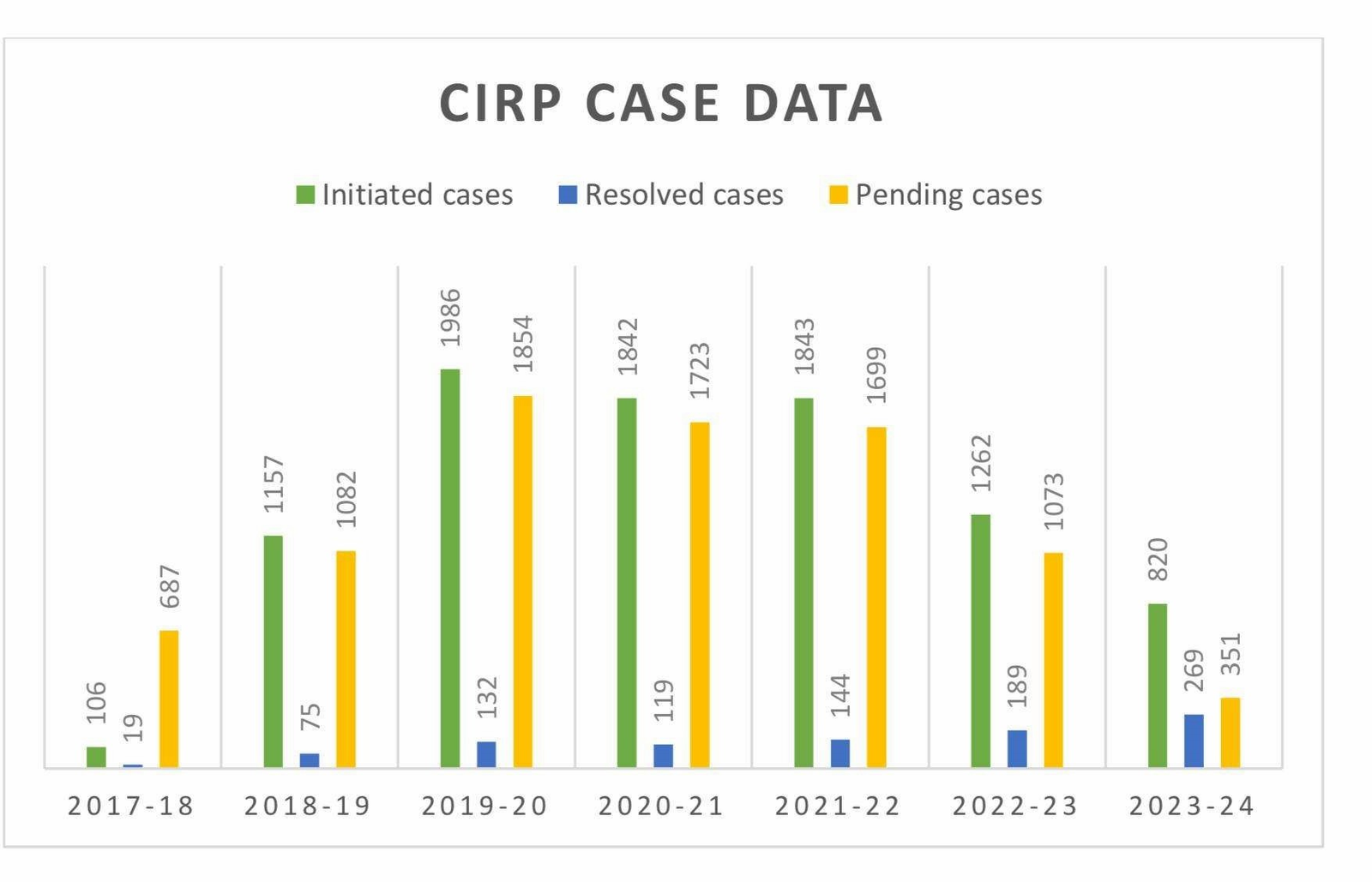
Figure 1 presents the CIRP case data by financial year. The data mentioned are as on 31 December 2024.28,29
Conclusion
To sum up, the Insolvency and Bankruptcy Code, 2016 is a historic change that has improved the corporate and financial environment in India. Although issues remain, the Code has shown itself to be a useful and adaptable legal framework for handling debt restructuring and corporate insolvency. The Insolvency and Bankruptcy Code (Amendment) Act, 2020, which replaced the Ordinance promulgated on 28 December 2019, modified the Code to streamline the corporate insolvency resolution process and to remove various obstacles and practical difficulties encountered in putting the Code’s provisions into practice; the relief for businesses hit by the COVID-19 pandemic came separately, through the Insolvency and Bankruptcy Code (Amendment) Ordinance, 2020, later enacted as the Second Amendment Act, 2020, which suspended the initiation of proceedings for pandemic-period defaults.30 The main points of the 2020 amendments are:31
• the insolvency commencement date is now the date on which the application to initiate the CIRP is admitted;
• the interim resolution professional is appointed on the date of admission of the application;
• the interim resolution professional continues to manage the affairs of the corporate debtor until the Adjudicating Authority approves a resolution plan or orders the liquidation of the corporate debtor, and a minimum threshold (100 creditors or 10 per cent of their number, whichever is less) has been established for financial creditors covered by Section 21(6A) and for real estate allottees;
• unless the corporate debtor fails to pay its current dues, no licence, concession, permit, quota, clearance or similar entitlement may be terminated or suspended during the moratorium;
• the new management and personnel are protected from prosecution for offences committed before the commencement of the CIRP, and the property of the corporate debtor is protected from attachment, confiscation, retention and the like for such offences.
*****
Footnotes
1. Insolvency and Bankruptcy Board of India & International Finance Corporation, Understanding the IBC: Key Jurisprudence and Practical Considerations, A Handbook (2020), https://www.ibbi.gov.in/uploads/whatsnew/e42fddce80e99d28b683a7e21c81110e.pdf.
2. Ministry of Finance, Government of India, Economic Survey 2015–16, vol. I, ch. 2, The Chakravyuha Challenge of the Indian Economy (2016), https://www.indiabudget.gov.in/budget2016-2017/es2015-16/echapter-vol1.pdf.
3. Law Commission of India, Twenty-Sixth Report: Insolvency Laws (1964), https://indiankanoon.org/doc/75676088/.
4. Jatin Jadwani & Pulkit Dua, The Evolution of Insolvency and Bankruptcy Laws in India, International Journal of Advanced Legal Research, vol. 3, issue 3 (2023), https://ijalr.in/volume-3-issue-3-2023/the-evolution-of-insolvency-and-bankruptcy-laws-in-india-jatin-jadwani-pulkit-dua/.
5. Law Commission of India, supra note 3.
6. India Const. sched. VII, List III, entry 9.
7. Insolvency and Bankruptcy Code, 2016, Wikipedia, https://en.wikipedia.org/wiki/Insolvency_and_Bankruptcy_Code,_2016 (last visited Sept. 6, 2026).
8. Puja Kumari, Decoding the Insolvency Laws in India, Think India Journal, vol. 22, issue 22 (Dec. 2019), https://papers.ssrn.com/sol3/papers.cfm?abstract_id=4461145.
9. Shreeja Athota, Reverting Back: A Critical Analysis of the Insolvency and Bankruptcy Code, Pen Acclaims, vol. 12 (Sept. 2020), https://pure.jgu.edu.in/id/eprint/2132/1/SSRN-id3710944.pdf.
10. Swiss Ribbons Pvt. Ltd. v. Union of India, (2019) 4 SCC 17 (India).
11. Drishti Saxena, Stages of Corporate Insolvency Process, IndiaFilings, https://www.indiafilings.com/learn/stages-of-corporate-insolvency-process/ (last visited Sept. 6, 2026).
12. Insolvency and Bankruptcy Board of India & International Finance Corporation, supra note 1.
13. Cyril Amarchand Mangaldas, Insolvency and Bankruptcy Code: Till Now and Beyond (2019), https://www.cyrilshroff.com/wp-content/uploads/2020/10/IBC-Till-Now-and-Beyond-1.pdf.
14. Innoventive Industries Ltd. v. ICICI Bank, (2018) 1 SCC 407 (India).
15. Pooja Mahajan, Finally, Supreme Court on IBC: Innoventive v. ICICI, Bar & Bench (Sept. 2, 2017), https://www.barandbench.com/columns/supreme-court-ibc-innoventive-vs-icici.
16. Vaishnavi Tripathi, Innovative Industries Ltd v. ICICI Bank & Anr., LawBhoomi (Nov. 5, 2022), https://lawbhoomi.com/m-s-innovative-industries-ltd-vs-icici-bank-anr/.
17. ArcelorMittal India Pvt. Ltd. v. Satish Kumar Gupta, (2019) 2 SCC 1 (India).
18. The Insolvency and Bankruptcy Code, 2016, No. 31, Acts of Parliament, 2016 (India), § 29A(c).
19. Argus Partners, ArcelorMittal India Private Limited v. Satish Kumar Gupta (Civil Appeal Nos. 9402–9405/2018) (Oct. 9, 2018), https://www.argus-p.com/updates/updates/arcelormittal-india-private-limited-v-satish-kumar-gupta-civil-appeal-nos9402-9405-2018/.
20. Committee of Creditors of Essar Steel India Ltd. v. Satish Kumar Gupta, (2020) 8 SCC 531 (India).
21. Summary of Landmark Judgment of Supreme Court in Committee of Creditors of Essar Steel India Limited vs Satish Kumar Gupta & Ors., in Insolvency and Bankruptcy Code, 2016, IBC Laws (Nov. 15, 2019), https://ibclaw.in/summary-of-landmark-judgment-of-supreme-court-in-committee-of-creditors-of-essar-steel-india-limited-vs-satish-kumar-gupta-ors-under-ibc/.
22. L. Viswanathan & Dhananjay Kumar, Essar Steel India Limited: Supreme Court Reinforces Primacy of Creditors Committee in Insolvency Resolution, India Corporate Law (Cyril Amarchand Mangaldas) (Nov. 18, 2019), https://corporate.cyrilamarchandblogs.com/2019/11/essar-steel-india-limited-supreme-court-reinforces-primacy-of-creditors-committee-insolvency-resolution/.
23. Athota, supra note 9.
24. Cyril Amarchand Mangaldas, supra note 13.
25. India Jumps 23 Places to Rank 77 in World Bank’s ‘Ease of Doing Business’ Index, Indian Express (Oct. 31, 2018), https://indianexpress.com/article/business/economy/india-world-bank-ease-of-doing-business-rank-5427852/.
26. Cyril Amarchand Mangaldas, supra note 13.
27. PRS Legislative Research, The Insolvency and Bankruptcy Code (Amendment) Ordinance, 2020, https://prsindia.org/billtrack/the-insolvency-and-bankruptcy-code-amendment-ordinance-2020 (last visited Sept. 6, 2026).
28. Analysis of Insolvency Cases under IBC as on 31.12.2024: CIRP Initiation, Closures, Recovery and Yield from Resolution Plan and Liquidation, IBC Laws (Mar. 19, 2025), https://ibclaw.in/analysis-of-insolvency-cases-under-ibc-as-on-31-12-2024-cirp-initiation-closures-recovery-and-yield-from-resolution-plan-and-liquidation/.
29. Ravi Mital, From Chairperson’s Desk: Record Resolutions by NCLT, IBBI Quarterly Newsletter (Jan.–Mar. 2024), at 5, https://ibbi.gov.in/uploads/resources/ae17460f98b2f326b16380f4a917c8a1.pdf.
30. PRS Legislative Research, supra note 27.
31. PRS Legislative Research, The Insolvency and Bankruptcy Code (Amendment) Ordinance, 2019, https://prsindia.org/billtrack/the-insolvency-and-bankruptcy-code-amendment-ordinance-2019 (last visited Sept. 6, 2026).