
Introduction
The Insolvency and Bankruptcy Code (IBC) of 2016 marked a significant shift in India’s approach to addressing corporate distress. By instituting a time-bound process for insolvency resolution, it significantly improved the bankruptcy law.1 One of the many innovations under the IBC that stands out as a flexible and efficient way to expedite the resolution process is the Pre-Packaged Insolvency Resolution Process (Pre-Packs).2 Drawing on experience around the world, this study looks at how Pre-Packs were developed under the IBC, their significance, their operation and the challenges they pose. The IBC significantly altered India’s insolvency resolution process by providing a more straightforward and efficient means of handling business crises. One noteworthy innovation among the various procedures adopted under the IBC is the Pre-Packaged Insolvency Resolution Process, which seeks to speed up the resolution process while preserving the value of the distressed firm.3 This paper examines the evolution of Pre-Packs under the IBC, their significance and the challenges associated with their implementation. It is important to understand the key differences between the CIRP and the PPIRP under the IBC, even though the PPIRP is currently available only to MSMEs.4 The resolution plan under the PPIRP is discussed and approved by the parties before being submitted to the adjudicating authority for final approval, in contrast to the formal bidding process under the CIRP.5 If the debtor and its creditors reach an informal agreement on a resolution plan, the PPIRP permits the corporate debtor to initiate proceedings, whereas the CIRP permits financial and operational creditors to do so as well.6 The PPIRP allows a shorter timeline for the conclusion of proceedings, within a maximum term of 120 days,7 as opposed to the 270-day CIRP limit (330 days including time spent in litigation),8 which is commonly exceeded.9
In the CIRP, the insolvency professional takes over the debtor’s management on behalf of the financial creditors, whereas in the PPIRP the existing management remains in charge of the corporate debtor’s management and affairs.10,11
Cost-effective: The PPIRP provides a hybrid framework that includes an informal resolution plan agreement which is subsequently approved by the adjudicating authority, giving the parties involved sufficient protection. Because the entire process takes less time and involves fewer parties than the CIRP, the PPIRP would prove more cost-effective.12
Need for bankruptcy laws in India
The main focus of current bankruptcy legislation and debt-restructuring statutes is the revitalisation of capital and the gradual reconstruction of debtors facing financial difficulty, so as to enable their rehabilitation and the continuation of their business,13 rather than the liquidation and termination of insolvency matters. Furthermore, there are other situations in which bankruptcy laws prohibit a business from continuing to operate once it has been struck out.14
We depend on the law to regulate everything. A decent society needs laws to guarantee that everyone’s rights are respected, and the purpose of legislation is to strike a balance between things that are advantageous to society. For instance, there would be chaos everywhere if there were no traffic laws. Consequently, we acknowledge that nothing can remain regulated until a mechanism is established to do so, and for us that mechanism is legislation. This also applies to insolvency and bankruptcy.15 Any modern business must borrow money in order to grow. On the other hand, creditors will become less interested in lending money if a business fails to meet its obligations.16 When we consider that the protection of lenders’ interests is necessary for the borrowing and lending process to continue, which in turn contributes to the growth of the national economy, we understand that everything is interconnected and fundamentally benefits us.17 This makes it imperative to ensure that this keeps happening and that a creditor’s interest is protected, which is why debt-related laws were necessary. The insolvency laws are merely helpful laws that were implemented to give honest debtors time and assurance in the event that they are clearly unable to fulfil their obligations because of a significant or unanticipated event.18 Their object also entails making sure that the debtor’s estate is distributed among his creditors in an impartial way and, on that basis, discharging him under specific guidelines from further liability for his obligations.19
When the law of bankruptcy is examined, it is evident that it has been neglected. If someone is declared insolvent, they are not viewed as trustworthy. Whatever may be said, the bankruptcy statute shields the debtor from the mistreatment, humiliation and shame inflicted by his creditors.
The evolution of bankruptcy laws in India
In 1828, the first insolvency courts of the Presidency towns were created under Act 9 Geo. 4, c. 73. In essence, these courts were established to aid insolvent debtors. They were separate courts as well as courts of record. Anybody who disagreed with the ruling of such a court could appeal to the Supreme Court, which was regarded as the highest court.20 The Supreme Court had the authority to hear applications for collection and transfer of assets in order to relieve the insolvency of the borrower or bankrupt, and it determined that such an application or demand must be stayed through the courts in order to be fair and substantial.21 The officers of the court of insolvency were appointed by the Supreme Court. One of these officials was regarded as an “ordinary appointee” or official assignee. If one lender initiated an application for adjudication and an adjudication order was issued, the indebted person’s interest in his property would be entrusted to that official on the strength of the application alone. Provision was also made for interim protection orders.22
Understanding the IBC
A strong insolvency regime has two applications. It facilitates the closure of unviable businesses and aids the survival of viable ones. The Insolvency and Bankruptcy Code, 2016 (IBC) was developed in order to implement such a system in India. Before the IBC, India lacked an efficient rescue mechanism as well as a feasible exit route for businesses. The IBC offers a market-driven, time-bound procedure for exiting when required and for resolving insolvency when practicable.
Reorganisation and insolvency resolution for individuals, partnership firms and corporate debtors (CDs) are handled by the IBC. A company that has defaulted on its payments is known as a CD. For a business entity that has not defaulted, the IBC also provides an alternative through a voluntary liquidation process. The provisions of the IBC pertaining to corporate persons became operative on December 1, 2016. With the exception of personal guarantors to CDs, the IBC’s insolvency resolution and bankruptcy provisions do not yet apply to partnership firms and individuals. The primary subjects of this paper are CD insolvency resolution and liquidation. Under the IBC, a CD’s exit mechanism is handled by a liquidation process, while its rescue mechanism is carried out through the corporate insolvency resolution process (CIRP). Accordingly, a CD’s insolvency process is split into two phases under the IBC: in the first phase a CIRP is used to attempt to resolve the CD’s default; if this fails, the CD is liquidated in the second phase. To reduce transaction costs and delays and to increase the efficiency of these operations, the IBC also creates a new regulatory ecosystem and envisions a related institutional infrastructure. This institutional infrastructure must function well in order to achieve the objectives of the IBC.
The four pillars of the IBC infrastructure
The IBC introduced four pillars that underpin the operationalisation of the insolvency legislation:
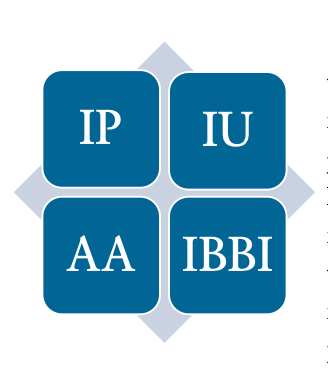
1. the IBBI, which has regulatory oversight over the IPs, IPAs, IPEs and IUs;
2. regulated and qualified IPs;
3. IUs; and
4. AAs.
The first pillar of the IBC’s institutional framework is made up of insolvency professionals,23 or IPs. An IP is one of the most important components of the IBC ecosystem.24 An IP is a registered and regulated professional who oversees and manages the resolution and bankruptcy process for individuals and partnerships, as well as the CIRP and/or the liquidation process of a CD.25 IPs are a crucial component that underpins the entire process of insolvency and bankruptcy. The IBC gives IPs a great deal of authority, but they are also governed by laws and regulations. The first level of regulatory monitoring is provided by the insolvency professional agency (IPA) with which the IP is enrolled.26 The Code also recognises the concept of an insolvency professional entity (IPE), which is a recognised service provider that supports insolvency professionals.27,28 IPs are helped in the bankruptcy, liquidation and insolvency resolution processes by information utilities (IUs), which are the second pillar of the institutional architecture.29 The IUs are authorised and regulated data repositories pertaining to CDs.30 For use in the bankruptcy, liquidation and insolvency resolution procedures, IUs collect, aggregate, authenticate and disseminate financial information. The judicial supervision of IPs is provided by the adjudicating authorities (AAs), the third pillar of the IBC’s institutional framework. Making sure that the bankruptcy, liquidation and insolvency resolution procedures are conducted in compliance with the IBC and its related rules and regulations is the responsibility of the AAs, which are specialised tribunals.31,32 The fourth pillar is the regulatory body, the Insolvency and Bankruptcy Board of India (IBBI).
The corporate insolvency resolution process (CIRP): procedures and legal framework
The IBC provides a process for resolving a CD’s insolvency known as the CIRP.33 The IBC prohibits the CD from being liquidated directly, with the exception of voluntary liquidation, which is allowed only if the CD has not defaulted on any debt.34 In contrast, a resolution process was not necessary before a company was wound up under the previous winding-up regime of the Companies Act, 1956 or the Companies Act, 2013 as originally enacted.35,36
If a CD defaults on an obligation, the CD or its creditor may request the jurisdictional AA to initiate a CIRP, in accordance with the IBC framework. Once a CIRP has started, every attempt is made to resolve and reorganise the CD.37 These efforts could lead to the following results:
• If a resolution plan is approved by the required majority of the CD’s CoC and subsequently approved by the AA through an order issued under section 31 of the IBC, the CD may be “resolved”; or
• The CD is not resolved through the CIRP if no resolution plan is received or approved for it, or if the CoC chooses to liquidate the CD before obtaining a resolution plan. If the insolvency is not resolved through the CIRP, the AA may issue an order under section 33 of the IBC to liquidate the CD, starting the liquidation process.
Each CIRP will therefore lead either to a liquidation order for the CD or to an order of the AA approving a resolution plan. It should be kept in mind that the IBC’s primary objective is to preserve and revitalise the CD (that is, to resolve). Only after the CIRP fails does liquidation take place.
A. What is the minimum default amount required to initiate CIRP against a corporate debtor?
• Until recently, ₹1 lakh was the minimum amount of default needed to initiate a CIRP. By a notification dated March 24, 2020, the Government increased the minimum amount of default to ₹1 crore.38
In the landmark case of Swiss Ribbons Pvt. Ltd. v. Union of India,39 the Supreme Court affirmed the IBC’s constitutionality and noted that its main goal is to reorganise and resolve the CD’s insolvency in a timely manner.
The NCLAT noted in Binani Industries Ltd. v. Bank of Baroda40 that the IBC’s first-order objective is resolution, its second-order objective is maximising the value of the firm’s assets, and its third-order objectives are promoting entrepreneurship, making credit available and balancing the interests of stakeholders. This order of objectives is sacrosanct.
B. The flowchart for the CIRP process
The IBC contains the procedures for starting and running the CIRP. In addition:
• The Central Government’s Application to Adjudicating Authority Rules describe the steps and processes for applying to the AA to initiate the CIRP.
• The IBBI has issued the CIRP Regulations, which outline the process and the various steps necessary to conduct a CIRP.
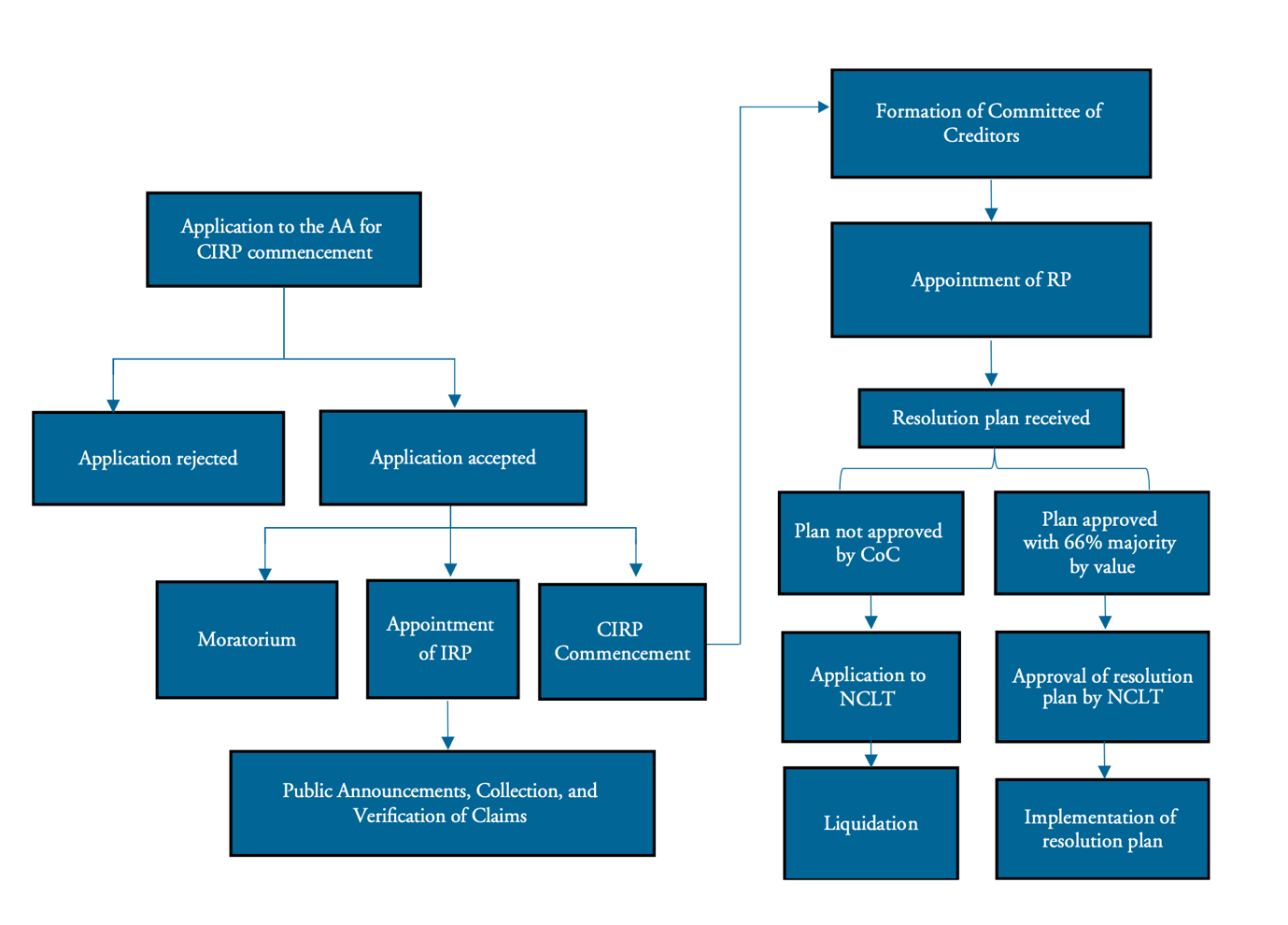
The flowchart below illustrates the CIRP process. The process starts with the filing of an application to begin the CIRP and ends with the AA’s decision to approve the resolution plan or to liquidate the CD.
C. The beginning of the CIRP
i. Default as the trigger
In the event that a CD defaults, an FC, an OC or the corporate applicant (including the CD itself) may initiate a CIRP for the CD in accordance with section 6 of the IBC by following the steps specified in Chapter II of Part II of the IBC.41,42 Consequently, a CIRP of the CD is initiated on the trigger of default.
The failure of the debtor or the CD, as applicable, to make full or partial payment of an obligation after it has become due and payable is referred to as “default” under section 3(12) of the IBC.43
Section 4 of the IBC states that Part II of the IBC, which addresses the CIRP and liquidation, applies to matters relating to the insolvency and liquidation of CDs where the minimum amount of default is ₹1 lakh. The Central Government may, by notification, set a higher minimum amount, but it cannot be more than ₹1 crore.44
The Central Government acknowledged the burden that COVID-19 was placing on businesses by issuing a notification on March 24, 2020 increasing the default threshold to ₹1 crore.45
The date on which the AA (of the jurisdiction where the CD is registered) issues an order admitting an application to initiate the CIRP of the CD, submitted by an FC, an OC or the corporate applicant, is known as the insolvency commencement date (ICD).
Legal framework and process for the pre-packaged insolvency resolution process (PPIRP)
The legislature continues to concentrate on the Insolvency and Bankruptcy Code, 2016 (the “Code”) to solve the implementation and operational problems that various market participants are encountering. The Insolvency Law Committee (“ILC”) was also created to accomplish this goal by, among other things, evaluating how the Code is being applied and periodically making pertinent recommendations. Since the Code’s creation, there have been five major legislative interventions as well as many other modifications. The primary objective is to establish an effective resolution process that is tailored to specific stakeholders and in line with market realities.46
On April 4, 2021, an ordinance known as the “2021 Ordinance”, read with the Insolvency and Bankruptcy Board of India (Pre-Packaged Insolvency Resolution Process) Regulations, 2021 (“PPIRP Regulations”)47 and the Insolvency and Bankruptcy (Pre-Packaged Insolvency Resolution Process) Rules, 2021 (“PPIRP Rules”),48 amended the Code to further this goal in relation to micro, small and medium enterprises (“MSMEs”), which have become increasingly important to the country’s economy (including under the 2020 Atmanirbhar Bharat initiative).
The “Pre-Packaged Insolvency Resolution Process” (also referred to as “Pre-Packaged IRP” or “PPIRP”) is a customised and alternative resolution process that the 2021 Ordinance offers to MSMEs. An outline of this process is provided below.49
In general, pre-packaged insolvency refers to the settlement of a distressed company’s debt by an agreement between a potential investor and the company’s unrelated financial creditors, as opposed to a public bidding process. This mechanism seeks to offer a practical and profitable resolution mechanism in the form of a private agreement between the financial creditors and potential investors by doing away with the technical and procedural constraints of public bidding.
A. PPIRP is governed by
• Sections 54A to 54P of the IBC;
• the Pre-Pack Rules, 2021; and
• the IBBI (Pre-Packaged Insolvency Resolution Process) Regulations, 2021.
B. Why is there a need for PPIRP?
Due to the cumulative stress caused by the COVID-19 pandemic, MSMEs are facing a cash-flow mismatch and need assistance with debt management, liquidity and other problems. The PPIRP provides an efficient alternative insolvency resolution process under the IBC that ensures faster, more cost-effective and value-maximising outcomes for all parties.
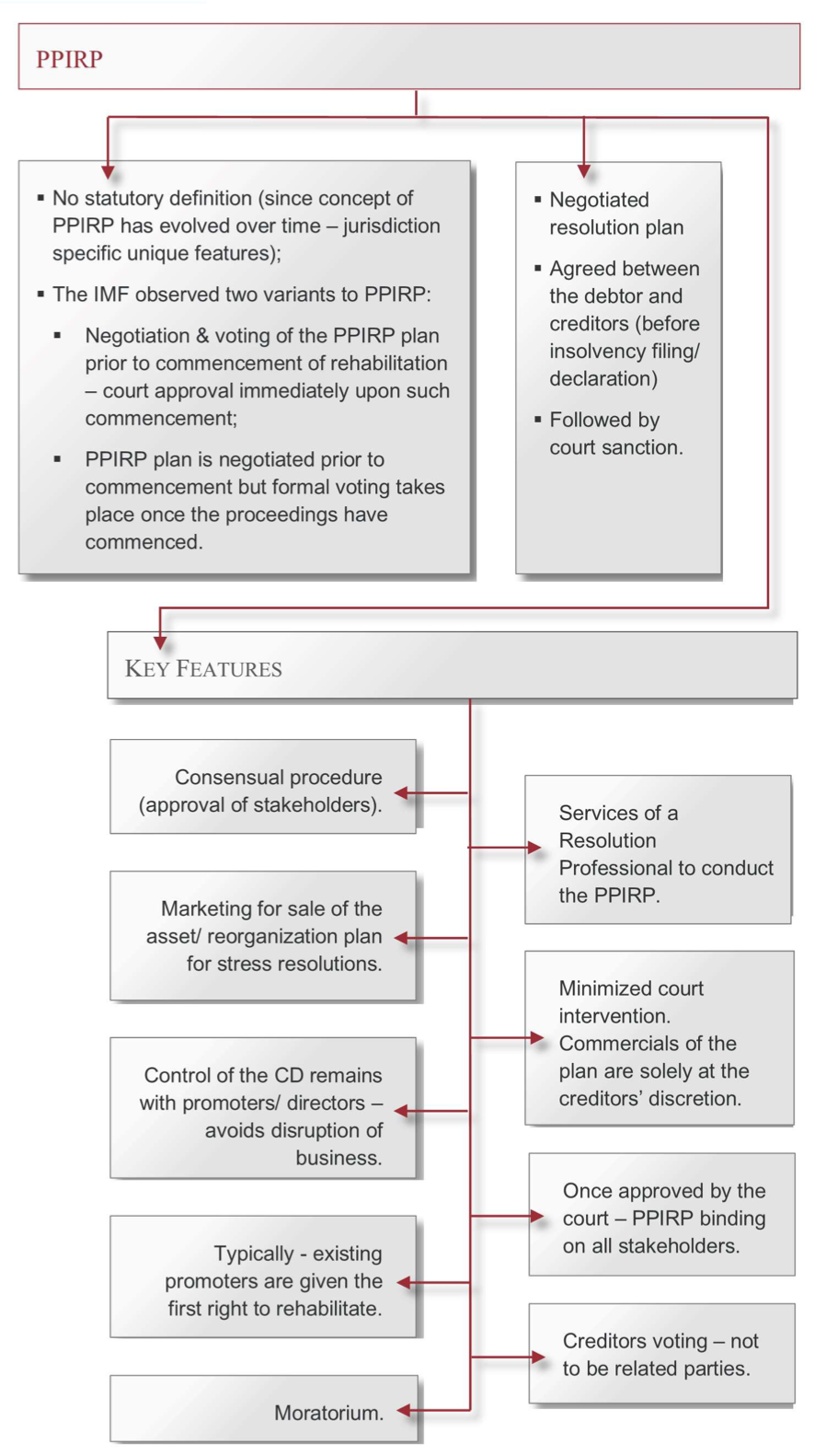
C. The 2021 Ordinance: pre-packaged insolvency resolution process
The Ordinance is only broadly depicted in this graphical representation, which was created to aid understanding of the process. See the details below, the IBC and the 2021 Ordinance for additional information.
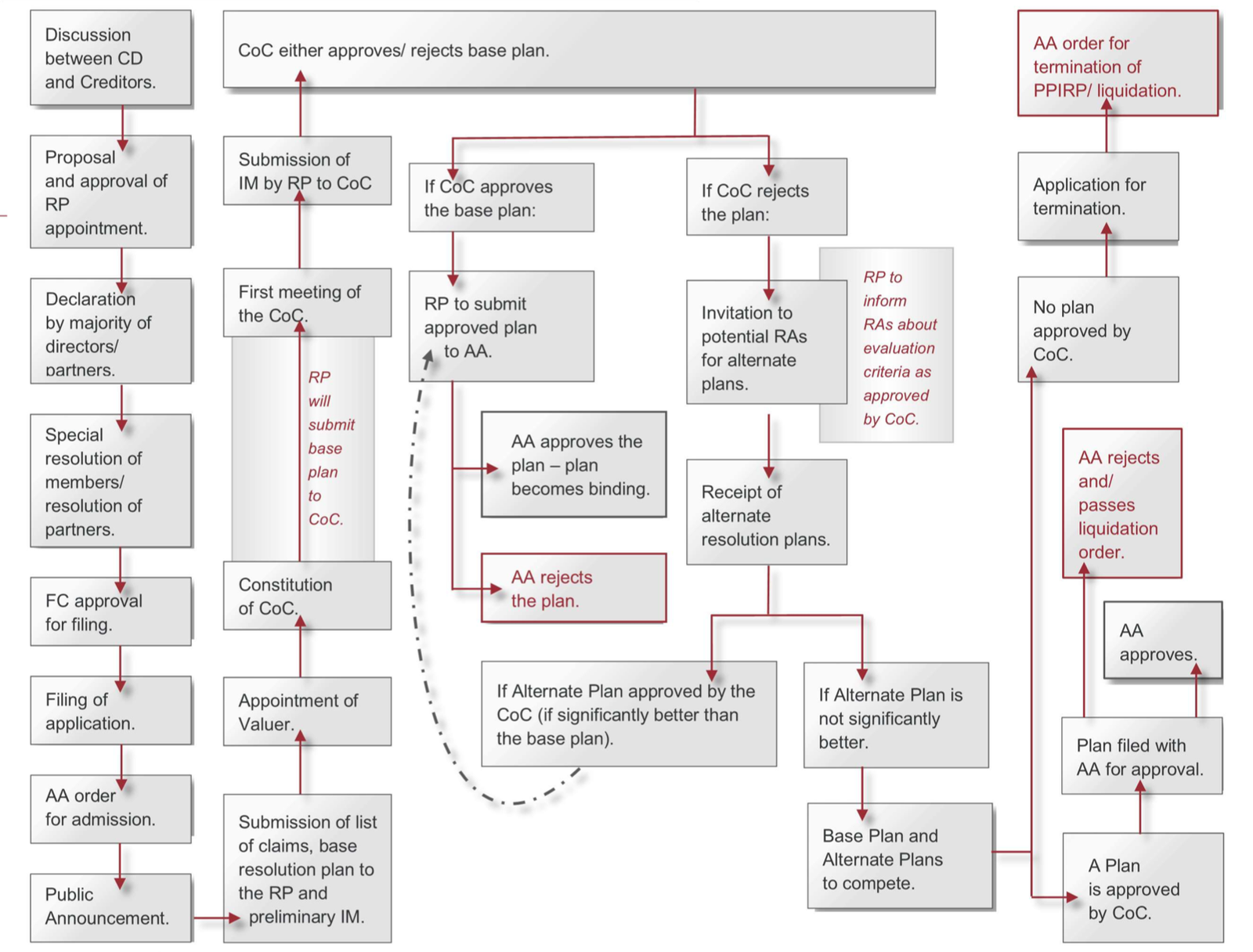
Note: The RP will concurrently form its opinion and, if required, submit an application before the AA regarding avoidance and fraudulent transactions. These applications will move forward in tandem with the process, regardless of termination, CIRP or liquidation.
D. Eligibility of corporate debtors
Section 54A of the Code lists the following requirements for beginning a Pre-Packaged IRP:
• If a corporate debtor is classified as an MSME under sub-section (1) of section 7 of the Micro, Small and Medium Enterprises Development Act, 2006, it may apply to begin the Pre-Packaged IRP.
• Additionally, a Pre-Packaged IRP may be started in the following circumstances if a corporate debtor commits a default within the designated quantum (as mentioned below):
• in the three years preceding the initiation date, the corporate debtor has neither completed a CIRP nor undergone a Pre-Pack IRP;
• it is not undergoing a CIRP;
• no order for its liquidation has been passed under section 33 (initiation of liquidation) of the Code;
• it is eligible to submit a resolution plan in line with section 29A of the Code;
• the name of the resolution professional for conducting the Pre-Packaged IRP must be proposed and approved by financial creditors who are not related parties of the corporate debtor, representing at least 66% in value of the financial debt due to such creditors; where there are no unrelated financial creditors, the proposal and approval must come from such persons as may be specified (“Approved Resolution Professional”);
• a declaration issued by the majority of the directors or partners of the corporate debtor, which states the following:
1. that the corporate debtor will file an application to start the Pre-Packaged IRP within a specified time frame of no more than ninety days;
2. that the Pre-Packaged IRP is not being initiated to defraud any person; and
3. the name of the resolution professional who was proposed and approved (“Director Declaration”);
• an application to begin a Pre-Packaged IRP must be approved by a special resolution of the shareholders or by at least three-fourths of the total number of partners of the corporate debtor.
• The corporate debtor must also obtain the approval of its unrelated financial creditors, representing at least 66% in value of the financial debt due to them, for filing the application to begin the pre-packaged insolvency resolution process, in Form P4. Where there are no unrelated financial creditors, such persons as may be specified will give the approval.
E. Who can file an application to initiate the PPIRP?
Any corporate entity, including a company or limited liability partnership, that is classified as an MSME under section 7(1) of the MSMED Act, 2006 (“Corporate Debtor”).
F. Which companies are classified as MSMEs?
Micro, small and medium enterprises (MSMEs) are businesses engaged in the manufacture, processing, production and preservation of goods, or in the provision of services. According to the current laws that apply to MSMEs, they are categorised according to the prescribed criteria of investment and turnover.
G. When can the PPIRP begin?
Section 3(12) of the Code defines “default” as non-payment of a debt when the debtor or corporate debtor, as applicable, fails to pay all or any part of the amount owed after it has become due and payable. If there is a minimum default of ₹10 lakh, a PPIRP can be initiated to assist the MSME company in resolving the issue.50 Defaults in multiple accounts totalling at least ₹10 lakh will suffice.
H. Does the MSME company need professional help during the PPIRP?
In fact, the MSME would need to engage an insolvency professional (IP). After advising the CD until the application is submitted to the AA, an IP is designated by the financial creditors as the resolution professional under the pre-pack framework for MSMEs. The IP may change or stay the same across these phases.
I. What is the timeline specified for the PPIRP?
The PPIRP shall be completed within 120 days from the date of commencement: 90 days for approval of the resolution plan by the CoC and 30 days for the adjudicating authority.
Comparing CIRP and PPIRP: key differences in use, management and timeliness under India’s insolvency code
The Corporate Insolvency Resolution Process (CIRP) and the Pre-Packaged Insolvency Resolution Process (PPIRP) are established by the Insolvency and Bankruptcy Code of India.51 The CIRP, which has a maximum 330-day schedule,52 is initiated by creditors or the debtor for defaults exceeding one crore rupees. The PPIRP is a 120-day process for micro, small and medium enterprises that was introduced in 2021.53 While the CIRP has a more statutory structure, the PPIRP relies more heavily on regulations. A resolution professional oversees the CIRP, whereas the PPIRP allows the debtor to remain in management. Both processes aim at resolution and have similar rules for transactions, financing and plan approval.54
A. Appointment of resolution professional
In the CIRP, both financial creditors and corporate applicants must propose the interim resolution professional. The interim resolution professional is appointed by the adjudicating authority; if an operational creditor does not propose an interim resolution professional, the AA appoints one on the recommendation of the IBBI, and the committee of creditors may later replace the interim resolution professional with a resolution professional.
To conduct the resolution process, the resolution professional in the PPIRP must be selected with the consent of the unrelated financial creditors.
B. What is the completion timeline for the insolvency resolution procedure?
Section 12(1) of the IBC states that the CIRP must be completed within 180 days of the date on which the NCLT admitted the application. The NCLT may grant a one-time extension of 90 days (subject to CoC approval). The maximum time within which the CIRP must be completed, including any extension and any period of litigation, is 330 days from the date the NCLT admitted the application.
The PPIRP must be completed within 120 days of the date on which the NCLT admitted the application, in accordance with section 54D of the IBC. Within ninety days of the date of admission, the RP must submit the resolution plan approved by the CoC to the NCLT. If the CoC does not approve a resolution plan within that period, the RP will file an application with the NCLT to terminate the process on the day after the period expires.
C. Corporate debtor oversight during the insolvency resolution procedure
In the CIRP, the RP oversees the corporate debtor’s operations. Under section 17(1)(c) of the IBC, the corporate debtor’s officers and managers must report to the RP, who has all the powers of the corporate debtor’s board of directors. During this period the RP complies with the CoC’s directions. Consequently, the corporate debtor is under the control of the CoC and the RP.
In contrast to the CIRP, the corporate debtor’s board of directors continues to oversee business operations while the PPIRP is pending.55 The directors are also responsible for protecting the value of the company’s assets and preserving its status as a going concern. During this period they remain responsible for discharging all of their contractual and statutory obligations in relation to the corporate debtor.56 The CoC may ask the corporate debtor for any information that may be required, and it may give directions or guidelines on the basis of which the corporate debtor may continue to manage the business. However, the RP may be vested with the management of the corporate debtor’s affairs under section 54J of the IBC, on the necessary orders of the NCLT, if the corporate debtor’s affairs have been grossly mismanaged or conducted in a fraudulent manner.57
D. Priority where both CIRP and PPIRP are sought to be initiated
Section 11A of the IBC states that if an application for initiation of a PPIRP is filed more than 14 days after the date of the application for initiation of a CIRP, the NCLT will decide the CIRP application first.
In accordance with section 11A of the IBC, if the PPIRP application is submitted within 14 days of the date of the application for initiation of a CIRP, or before the application for initiation of a CIRP, the NCLT is required to admit or reject it before considering the application for commencement of the CIRP. As a result, when applications are submitted for both a CIRP and a PPIRP, the PPIRP is given priority. This is important because any operational or financial creditor may ask for a CIRP to begin immediately in the event of a default. It gives a corporate debtor that is already contemplating a PPIRP the opportunity to deal with its insolvency through that route.
E. Conversion of the insolvency resolution process
A CIRP cannot be converted into a PPIRP once it has begun. Section 54A of the IBC states that for a PPIRP to start, the corporate debtor must not be undergoing a CIRP. Section 54O of the IBC states that at any time after the PPIRP begins but before the resolution plan is approved, the CoC may resolve to initiate a CIRP against the corporate debtor by a vote of 66% of its voting share. If the CoC makes such a determination, the RP intimates the NCLT, which may then issue an order terminating the PPIRP and initiating the corporate debtor’s CIRP.
Key judicial pronouncements
A. Lalit Kumar Jain v. Union of India
i. Legal issue involved
Concerning individuals who had given personal guarantees to corporate debtors, the Government of India’s notification bringing into force the provisions of Part III of the IBC (that is, the insolvency resolution and bankruptcy process for personal guarantors) was challenged as unconstitutional.58
ii. Supreme Court judgment
The Supreme Court of India put to rest a major controversy that had erupted in 2020, when certain high-profile industrialists (who were also personal guarantors to various corporate debtors under personal guarantees) (“Petitioners”) challenged that part of the Insolvency and Bankruptcy Code, 2016 (“IBC”) which pertained to the initiation of personal insolvency against personal guarantors when the corporate debtor for whose benefit the personal guarantee was given was under the corporate insolvency resolution process. The brief facts are that certain industrialists, who had issued personal guarantees as security for facilities granted to corporate entities in which they were interested as directors or promoters, challenged the constitutional vires of the notification and rules issued by the Ministry of Corporate Affairs (“MCA”) and the regulations issued by the Insolvency and Bankruptcy Board of India (“IBBI”) which notified those provisions of the IBC that granted lenders the option of initiating personal insolvency against personal guarantors in cases where the company was already under the corporate insolvency resolution process or the liquidation process under the IBC. While these petitions were pending before the Delhi High Court and a batch of other petitions had been filed in other High Courts on the same issue, an application was moved before the Supreme Court of India (“SC”) to transfer all these matters to the SC, which was allowed. Thus, all matters in this regard were consolidated in a common proceeding before the SC.
This is a significant development, as it gives lenders the relief and freedom to proceed simultaneously against the personal guarantors as well as the companies for recovery of their dues, thereby ensuring that promoters who are personal guarantors have to deal with their own insolvency and do not become an impediment or roadblock in the insolvency proceedings of the corporate debtor. Simultaneous proceedings will be useful in finding a holistic and composite recovery for the lenders and a resolution of the corporate debtor, as the assets of the promoters would also be brought into the fold for the purposes of recovery of dues to the creditors and resolution of the corporate debtor. It is hoped that this will now compel promoters, in their capacity as personal guarantors, to try to agree on a settlement with the lenders, whether under a repayment plan or by way of a one-time settlement.
B. Basavaraj Koujalagi v. Sumit Binani, liquidator of Gujarat NRE Coke Limited
The National Company Law Tribunal, Kolkata (“NCLT”) first rejected prayer (c) and stated that the adjudicating authority cannot step into the shoes of the liquidator and examine the commercial viability of terminating a contract.59 The liquidator is responsible for the affairs of the company in liquidation, and if a decision is taken by him in the best interests of the company, then the matter should be left at that. Further, JMPL had all the resources and the legal framework to challenge the termination of the contract, from which it can be inferred that JMPL was not aggrieved by the termination. With regard to prayer (a), the NCLT found that the wages of the workers had been paid by the liquidator on the basis of the wage sheet, which was satisfactory, owing to the fact that limited cash flow was available with the company.
While considering prayer (b), the NCLT found that the liquidator had taken every possible step to keep the Dharwad plant operational. Keeping in mind the objectives of the IBC, one of which is to free up the resources of unviable companies by permitting an easy exit, the NCLT held that unviable units such as the company have to close down. The NCLT also rejected prayer (d), stating that in the absence of any allegation of fraud or bias in the decisions of the liquidator, an order for an inquiry cannot be made on the basis of the perceived loss of employment of the workers on account of a business decision taken by the liquidator to terminate the arrangement with JMPL.
Conclusion
The PPIRP and the CIRP are complementary tools in India’s insolvency toolbox. The CIRP is still essential where strict control, creditor competition and open market discovery are required. The PPIRP closes a large gap in the market by providing quick, less expensive restructuring that is especially suitable for MSMEs, provided that robust protections for transparency, conflict resolution and judicial review are maintained. Ongoing empirical observation and incremental regulatory improvement are necessary to ensure that the new route offers value without jeopardising creditor protection or public trust.
In India there are presently about 6.3 crore MSMEs, and the number of registered MSMEs is steadily rising.60 Since the PPIRP would require minimal disruption to business operations, with management retained and in control of the corporate debtor’s affairs, many stakeholders would benefit from its implementation. The PPIRP’s cost-effectiveness and speed of resolution make it a worthwhile substitute for the other existing insolvency resolution processes. It remains to be seen whether the PPIRP, as an insolvency resolution mechanism, gains the same level of popularity in India as pre-packs enjoy in other jurisdictions and is soon made available to all corporate entities (not only MSMEs), or whether the PPIRP will become entangled in India’s problems of stakeholder awareness and inadequate infrastructure.
*****
Footnotes
1. The Insolvency and Bankruptcy Code, No. 31 of 2016, pmbl., India Code (2016).
2. Id. § 12 (mandating a time-bound insolvency resolution framework).
3. Bankruptcy Law Reforms Comm., The Report of the Bankruptcy Law Reforms Committee, Volume I: Rationale and Design 25–28 (2015), https://ibbi.gov.in/BLRCReportVol1_04112015.pdf.
4. The Insolvency and Bankruptcy Code (Amendment) Ordinance, No. 3 of 2021 (India) (inserting Chapter III-A, which provides a pre-packaged insolvency resolution process for corporate debtors classified as MSMEs; the Ordinance, promulgated on Apr. 4, 2021, was replaced by the Insolvency and Bankruptcy Code (Amendment) Act, No. 26 of 2021, which received assent on Aug. 11, 2021 and is deemed to have come into force on Apr. 4, 2021).
5. Insolvency and Bankruptcy Code §§ 54A–54P (as inserted by the Insolvency and Bankruptcy Code (Amendment) Ordinance, No. 3 of 2021).
6. See generally Insolvency and Bankruptcy Board of India (Pre-Packaged Insolvency Resolution Process) Regulations, 2021, Gazette of India, pt. III, sec. 4 (Apr. 9, 2021).
7. Insolvency and Bankruptcy Code § 54D(1) (120-day completion timeline for the PPIRP).
8. Id. § 12(2)–(3) (180-day period for the CIRP, extendable by a further 90 days, subject to an outer limit of 330 days including any extension and the time taken in legal proceedings).
9. For global comparative models, see INSOL Int’l, Statement of Principles for a Global Approach to Multi-Creditor Workouts (2000), https://insol.azureedge.net/cmsstorage/insol/media/document-library/books/statement-of-principles-for-a-global-approach-to-multi-creditor-workouts.pdf.
10. Insolvency and Bankruptcy Code § 17(1) (vesting the management of the affairs of the corporate debtor in the interim resolution professional from the date of his appointment in a CIRP).
11. Id. § 54H(a) (providing that, during the PPIRP, the management of the affairs of the corporate debtor continues to vest in its Board of Directors or partners).
12. Compare Insolvency and Bankruptcy Code § 54K (consideration and approval by the committee of creditors of a base resolution plan negotiated with the corporate debtor) with id. § 30(2) (requirements of a resolution plan submitted in a CIRP).
13. See Bankruptcy Law Reforms Comm., supra note 3, at 9–14 (noting the policy shift toward preserving enterprise value and enabling debtor rehabilitation rather than relying on liquidation).
14. See Insolvency and Bankruptcy Code §§ 14, 17 (imposing a moratorium and transferring control of the corporate debtor to the insolvency professional, thereby restricting unauthorised business operations once insolvency proceedings begin).
15. See Lon L. Fuller, The Morality of Law 33–38 (1964) (explaining that legal rules are essential for maintaining social order and guiding human conduct).
16. See Bankruptcy Law Reforms Comm., supra note 3, at 6–11 (explaining that credit markets depend on legal mechanisms that protect lenders’ interests and promote economic growth).
17. See Thomas H. Jackson, The Logic and Limits of Bankruptcy Law 7–19 (1986) (discussing bankruptcy law as a collective debt-collection device designed to prevent creditor disarray and ensure fairness).
18. See Insolvency and Bankruptcy Code, pmbl. (stating that the purposes of the Code include balancing the interests of all stakeholders and providing time-bound mechanisms for resolving financial distress).
19. See U.N. Comm’n on Int’l Trade Law, Legislative Guide on Insolvency Law pt. one, ch. I, ¶¶ 1–4 (2005), https://uncitral.un.org/sites/uncitral.un.org/files/media-documents/uncitral/en/05-80722_ebook.pdf (noting that insolvency frameworks exist to ensure equitable treatment of creditors and provide relief to honest but unfortunate debtors).
20. See Insolvent Debtors (East Indies) Act 1828, 9 Geo. 4, c. 73 (Eng.) (establishing courts for the relief of insolvent debtors in the Presidency towns of Calcutta, Madras and Bombay); see also Dinshah Fardunji Mulla, The Law of Insolvency in India 5–7 (5th ed. 1958) (noting that these courts functioned as courts of record and that appeals from their decisions lay to the Supreme Courts of the respective Presidency towns).
21. Mulla, supra note 20, at 12–16 (describing the supervisory authority of the Supreme Courts of the Presidency towns over insolvency matters, including their power to stay proceedings, direct the collection and transfer of assets, and appoint officials to administer the debtor’s estate).
22. P.R. Ganapathi Iyer, The Law of Insolvency in British India 21–27 (1907) (explaining that official assignees, referred to as “ordinary appointees”, were entrusted with the bankrupt’s property and acted under orders of the Supreme Court to ensure fair distribution among creditors and to enforce adjudication orders).
23. Insolvency and Bankruptcy Code §§ 3(19), 206 (defining insolvency professionals and requiring their enrolment with an insolvency professional agency and registration with the Board).
24. Id. §§ 206–208 (enrolment and registration of insolvency professionals and their functions and obligations).
25. See Insolvency and Bankruptcy Board of India (Insolvency Professionals) Regulations, 2016, regs. 4–7 (specifying eligibility, qualifications, application and certificate of registration for IPs).
26. Insolvency and Bankruptcy Code §§ 199–205 (providing for the registration of insolvency professional agencies and prescribing their functions and bye-laws for regulating and monitoring IPs).
27. Id. § 3(20) (defining “insolvency professional entity”).
28. See Insolvency and Bankruptcy Board of India (Insolvency Professionals) Regulations, 2016, supra note 25, reg. 12A (providing the framework for recognition of insolvency professional entities).
29. Insolvency and Bankruptcy Code §§ 3(21), 209–215 (defining information utilities and outlining their registration and their functions in storing, authenticating and providing financial information).
30. See Insolvency and Bankruptcy Board of India (Information Utilities) Regulations, 2017, regs. 3–23 (specifying registration requirements, governance, technical standards and the operational framework for IUs).
31. Insolvency and Bankruptcy Code §§ 5(1), 60–61 (establishing the National Company Law Tribunal as the adjudicating authority for corporate persons and providing for appeals from its orders).
32. Id. §§ 179–180 (designating the Debt Recovery Tribunal as the adjudicating authority for individuals and partnership firms and barring the jurisdiction of civil courts in such matters).
33. Insolvency and Bankruptcy Code §§ 6–12 (establishing the corporate insolvency resolution process and laying down its procedural framework).
34. Id. § 33(1)–(2) (providing that a liquidation order is passed where no resolution plan is received or approved, or where the committee of creditors resolves to liquidate the corporate debtor); see also id. § 59 (voluntary liquidation).
35. Id. § 59(1) (permitting a corporate person that has not committed any default to liquidate itself voluntarily).
36. The Companies Act, No. 18 of 2013, §§ 270–271, India Code (2013) (as originally enacted) (continuing to provide for winding up without requiring a resolution process prior to dissolution, before the transfer of most winding-up matters to the IBC).
37. See Bankruptcy Law Reforms Comm., supra note 3, at 35–38 (explaining that the IBC replaced the fragmented winding-up system under the Companies Act with a uniform, resolution-first approach).
38. Ministry of Corporate Affairs, Notification S.O. 1205(E) (Mar. 24, 2020) (specifying, under the proviso to section 4 of the Insolvency and Bankruptcy Code, one crore rupees as the minimum amount of default).
39. Swiss Ribbons Pvt. Ltd. v. Union of India, (2019) 4 SCC 17 (India).
40. Binani Industries Ltd. v. Bank of Baroda, Company Appeal (AT) (Insolvency) No. 82 of 2018 (NCLAT Nov. 14, 2018) (India).
41. Insolvency and Bankruptcy Code § 6 (permitting a financial creditor, an operational creditor or the corporate applicant, including the corporate debtor itself, to initiate a CIRP upon default).
42. Id. §§ 7–10 (setting out the procedural requirements for initiation of a CIRP by financial creditors, operational creditors and corporate applicants under Chapter II of Part II).
43. Id. § 3(12) (defining “default” as non-payment of a debt when the whole or any part or instalment of the amount of debt has become due and payable and is not paid by the debtor or the corporate debtor, as the case may be).
44. Id. § 4 (applying Part II where the minimum amount of default is one lakh rupees and empowering the Central Government to specify, by notification, a higher minimum amount not exceeding one crore rupees).
45. See Notification S.O. 1205(E), supra note 38.
46. The Insolvency and Bankruptcy Code (Amendment) Ordinance, No. 3 of 2021, pmbl. (India) (reciting the need for an efficient alternative insolvency resolution process for corporate persons classified as MSMEs, ensuring quicker, cost-effective and value-maximising outcomes for all stakeholders).
47. Insolvency and Bankruptcy Board of India (Pre-Packaged Insolvency Resolution Process) Regulations, 2021, supra note 6.
48. Ministry of Corporate Affairs, Insolvency and Bankruptcy (Pre-Packaged Insolvency Resolution Process) Rules, 2021, G.S.R. 256(E), Gazette of India, pt. II, sec. 3(i) (Apr. 9, 2021).
49. See id.; The Insolvency and Bankruptcy Code (Amendment) Ordinance, No. 3 of 2021, pmbl. & § 8 (India) (inserting Chapter III-A into the Code).
50. Ministry of Corporate Affairs, Notification S.O. 1543(E) (Apr. 9, 2021) (specifying, under the second proviso to section 4 of the Insolvency and Bankruptcy Code, ten lakh rupees as the minimum amount of default for the pre-packaged insolvency resolution process under Chapter III-A).
51. Insolvency and Bankruptcy Code § 4, first proviso, read with Notification S.O. 1205(E), supra note 38 (raising the minimum default for initiation of a CIRP to ₹1 crore).
52. Insolvency and Bankruptcy Code § 12(3) (providing an outer limit of 330 days for completion of the corporate insolvency resolution process).
53. The Insolvency and Bankruptcy Code (Amendment) Ordinance, No. 3 of 2021, pmbl. & § 8 (India) (introducing the pre-packaged insolvency resolution process for MSMEs).
54. Insolvency and Bankruptcy Code §§ 25A–30, 54P (applying sections 24, 25A, 26, 27, 28, 29A, 32A and 43 to 51 and Chapters VI and VII of Part II, mutatis mutandis, to the pre-packaged insolvency resolution process); Insolvency and Bankruptcy Board of India (Insolvency Resolution Process for Corporate Persons) Regulations, 2016, regs. 35–39 (setting out provisions on valuation, the information memorandum, resolution plans and their approval).
55. Insolvency and Bankruptcy Code § 54H(a)–(b) (providing that management continues to vest in the Board of Directors or partners, who must make every endeavour to protect and preserve the value of the corporate debtor’s property and manage its operations as a going concern).
56. Id. § 54H(c) (requiring the promoters, members, personnel and partners of the corporate debtor to exercise and discharge their contractual and statutory rights and obligations during the PPIRP).
57. Id. § 54J(1)–(2) (permitting the committee of creditors, by a vote of not less than 66% of the voting shares, to resolve to vest the management of the corporate debtor with the resolution professional, and requiring the adjudicating authority to pass such an order where the affairs of the corporate debtor have been conducted in a fraudulent manner or there has been gross mismanagement).
58. Lalit Kumar Jain v. Union of India, (2021) 9 SCC 321 (India) (upholding the Central Government’s notification of Nov. 15, 2019 bringing personal guarantors to corporate debtors within Part III of the Insolvency and Bankruptcy Code).
59. Basavaraj Koujalagi v. Sumit Binani, Liquidator of Gujarat NRE Coke Ltd., IA No. 865/KB/2020 in CP (IB) No. 182/KB/2017 (NCLT Kolkata May 3, 2021) (India) (deciding an application under section 60(5) of the Insolvency and Bankruptcy Code by the workmen of the Dharwad unit during the liquidation of Gujarat NRE Coke Ltd.).
60. According to the 73rd round of the National Sample Survey (2015–16), there were 633.88 lakh unincorporated non-agricultural MSMEs in India. Prachi Apte & Sushanta Kumar Das, Treatment of MSME Insolvency under IBC 280 (Insolvency & Bankruptcy Bd. of India 2021), https://ibbi.gov.in/uploads/resources/b7dfd3332bc133fde5783cf70b9371a1.pdf (citing Nat’l Sample Survey Office, Ministry of Statistics & Programme Implementation, NSS 73rd Round, 2015–16).